
 العربية


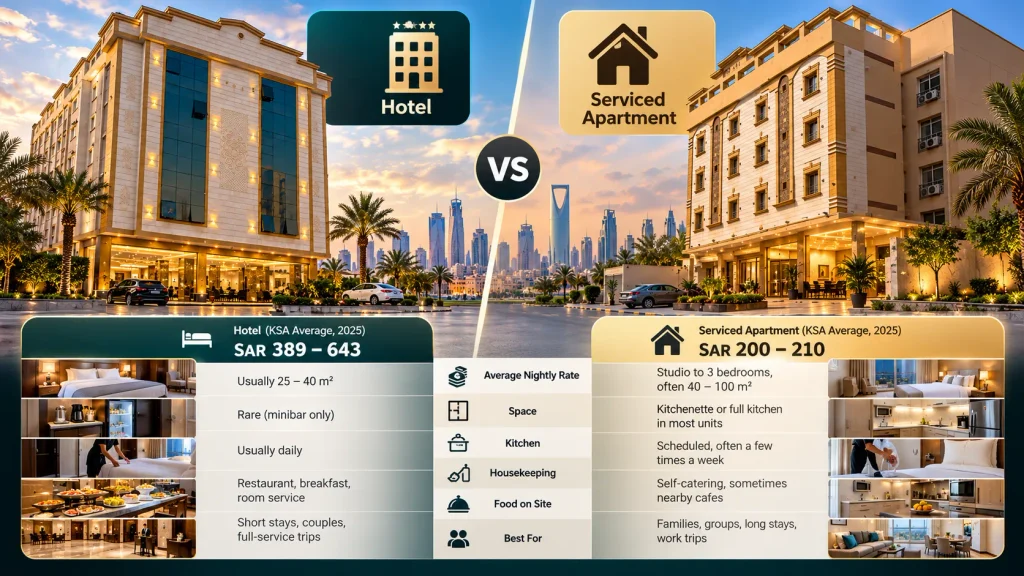
A serviced apartment gives you more space, a kitchen and a lower nightly rate, which makes it the better pick for families, groups and stays longer than a few nights. A hotel gives you daily housekeeping, restaurants and more on-site service, which suits short trips and travellers who do not want to cook. In Saudi Arabia, official GASTAT figures for 2025 put the average serviced apartment rate at roughly SAR 200 to 210 a night, against SAR 389 to 643 for hotels depending on the quarter.
Choosing between a serviced apartment and a hotel in Saudi Arabia is mostly a question of how long you are staying, how many people are with you and how much service you want each day. Price matters too, and the gap is bigger than most travellers expect.
This guide compares both options using official Saudi statistics and real rate examples from Best Trip, a Jeddah operator that runs both serviced apartments and a hotel. You will see where each one wins, where it loses and how the total bill changes over 1, 7 and 30 nights.
Serviced Apartment vs Hotel: The Key Differences at a Glance
The table below sums up how the two stay types usually compare in Saudi Arabia. Individual properties vary, so treat it as a general guide.
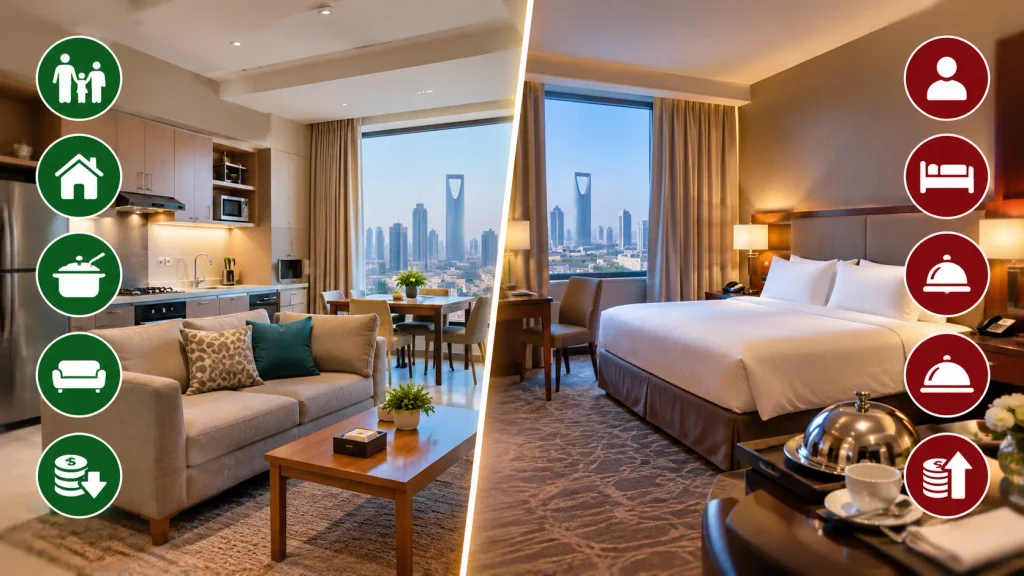
| Factor | Serviced apartment | Hotel |
|---|---|---|
| Typical nightly rate (KSA average, 2025) | About SAR 200 to 210 | About SAR 389 to 643 |
| Space | Studio to 3 bedrooms, often 40 to 100 m² | Usually one room, often 25 to 40 m² |
| Kitchen | Kitchenette or full kitchen in most units | Rare, usually a minibar only |
| Living area | Separate lounge in 1BR and larger units | Rare outside suites |
| Housekeeping | Scheduled, often a few times a week | Usually daily |
| Food on site | Self-catering, sometimes nearby cafes | Restaurant, breakfast, room service |
| Best for | Families, groups, long stays, work trips | Short stays, couples, full-service trips |
| Monthly rates | Common and usually discounted | Less common |
How Much More Space Do You Get?
Space is the clearest difference. A standard hotel room is one room with a bed, a desk and a bathroom. A serviced apartment adds rooms around that.
At Best Trip, a studio starts at 40 m² and a one-bedroom unit runs 60 to 80 m². Two-bedroom apartments reach 65 to 100 m² depending on the branch. That is two or three times the floor area of a typical city hotel room.
The extra space changes how a stay feels. Children can sleep in a separate room. One person can work at the table while another rests. Luggage for a long trip has somewhere to go.
For couples on a two-night trip, this space matters less. For a family of five staying a week, it often decides the choice on its own.
What Each Option Costs Per Night in Saudi Arabia
Official data from the General Authority for Statistics (GASTAT) gives a clean comparison, because it tracks hotels and serviced apartments separately every quarter.
| Period (2025) | Hotel ADR | Serviced apartment ADR | Hotel occupancy | Serviced apartment occupancy |
|---|---|---|---|---|
| Q1 | About SAR 477 | About SAR 209 | About 63% | 50.7% |
| Q2 | SAR 643 | SAR 201 | 53.2% | 50.2% |
| Q4 | About SAR 389 | About SAR 207 | 57.3% | 55.9% |
ADR means Average Daily Rate, the average price paid per occupied room or unit per night.
Two patterns stand out. First, hotel prices swing a lot across the year, from about SAR 389 to SAR 643, because of seasons, events and Umrah demand. Second, serviced apartment prices stay close to SAR 200 to 210 in every quarter, which makes budgeting easier.
Regional figures for Q2 2025 tell the same story. In the Makkah region, which includes Jeddah, hotels averaged SAR 450 and serviced apartments SAR 213. In Riyadh, the gap was wider, with hotels at SAR 743 and serviced apartments at SAR 239. In Madinah, hotels averaged SAR 681 against SAR 190 for serviced apartments.
GASTAT does not publish a separate figure for Jeddah, so the Makkah region number is the closest official guide for the city.
Real Price Examples: 1, 7 and 30 Nights
Averages are useful, but a real rate card shows what a booking actually costs. The examples below come from Best Trip’s published rates in October 2026. Best Trip runs serviced apartment branches and one hotel, Al Andalus Tolen, all in Jeddah.
Totals add 15% VAT and a 2.5% municipality fee to the base rate. They are approximate and are shown only to compare scale.
| Unit | Type | Size | Base rate per night | Approx. 1 night with taxes | Approx. 7 nights | Approx. 30 nights |
|---|---|---|---|---|---|---|
| Studio, Marsilia | Serviced apartment | 40 m² | SAR 102.50 | SAR 120 | SAR 840 | SAR 3,600 |
| 1 bedroom, Best Trip Paris | Serviced apartment | 70 m² | SAR 128 | SAR 150 | SAR 1,050 | SAR 4,500 |
| 2 bedroom, Best Trip Paris | Serviced apartment | 90 m² | SAR 162 | SAR 190 | SAR 1,330 | SAR 5,700 |
| Studio, Al Andalus Tolen | Hotel | 30 m² | SAR 132 | SAR 155 | SAR 1,090 | SAR 4,650 |
| Junior Suite, Al Andalus Tolen | Hotel | 50 m² | SAR 145 | SAR 170 | SAR 1,190 | SAR 5,100 |
A two-bedroom apartment of 65 m² costs less per night than a 30 m² hotel studio. Over a week, the difference is more than SAR 550. Over a month, it passes SAR 2,400.
The 30-night column uses the nightly rate for a fair comparison. In practice, long stays at serviced apartments are usually quoted as monthly rates, which are often lower. Hotels rarely discount that deeply for a month.
Service and Housekeeping: What You Give Up
A hotel is built around service. Daily room cleaning, fresh towels, a restaurant, room service and a concierge are normal. You do very little for yourself.
A serviced apartment sits in between a hotel and a rental. You get a reception desk, cleaning on a schedule, linen changes and maintenance support. You do not usually get a restaurant or daily turndown.
At Best Trip, every branch has a 24-hour reception, free Wi-Fi and free parking. Extra linen and cleaning visits are available on request through reception. The Best Trip services list shows what is included at each property.
If you want someone to handle everything, a hotel fits better. If you are happy to make your own coffee and tidy the table, a serviced apartment gives you more for less.
Kitchen and Food: The Hidden Cost Difference
Food is where a long hotel stay quietly gets expensive. Eating every meal out or ordering room service for a week adds up fast, especially for a family.
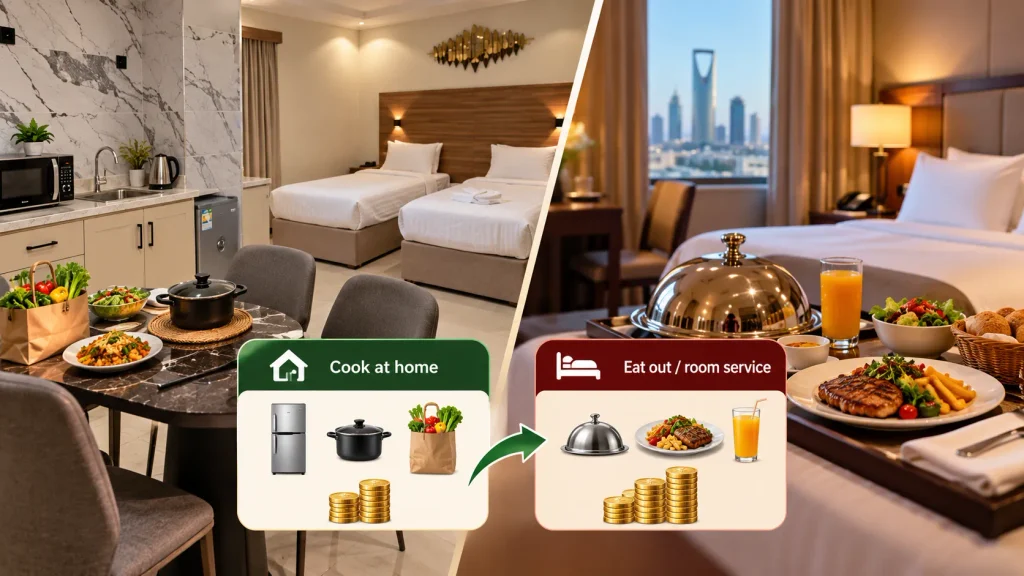
Most serviced apartments come with a kitchenette or full kitchen. That usually means a fridge, a stove or hob, a microwave, a kettle and basic cookware. You can keep breakfast at home, pack lunches and cook simple dinners.
For a family of four, cooking even one meal a day can save more than the room rate difference itself. This is often the deciding factor for visitors staying in Jeddah for medical treatment, school terms or work projects.
Hotels have one real advantage here. If breakfast is included, it is convenient and needs no planning. Check whether the rate includes it before comparing prices.
Which Is Better for Families and Groups?
For families, serviced apartments usually win on three counts: separate bedrooms, a kitchen and a living room where everyone can sit together.
In a hotel, a family of five often needs two connecting rooms. That doubles the cost and still leaves no shared space other than the beds. A two-bedroom apartment keeps everyone under one door at a lower total.
Groups of friends or colleagues get the same benefit. Sharing a two- or three-bedroom unit spreads the cost and keeps the group together.
A hotel can still suit a family on a one- or two-night stopover, when space matters less than pool access or an on-site restaurant.
How Length of Stay Changes the Answer
Length of stay is the single strongest signal for which option to pick.
- 1 to 3 nights: A hotel is often easier. You will barely use a kitchen, and daily service is a nice extra.
- 4 to 14 nights: A serviced apartment starts to pay off, especially for families or anyone who wants to cook.
- 15 nights or more: A serviced apartment is almost always the better value, and monthly rates widen the gap further.
GASTAT data shows that the average guest in the serviced apartment category stays about 2.1 to 2.2 nights, against about 3.8 to 4.1 nights in hotels. That category includes other hospitality facilities, not just apartments, so it does not mean apartments are only for short stays. Long-stay guests often book directly on monthly terms, which these averages do not fully capture.
Travellers planning a month or more in Jeddah often look at monthly serviced apartments because the per-night cost drops while the space stays the same.
Business Trips: Desk, Wi-Fi and Routine
For a short business trip with meetings every day, a hotel works well. Breakfast, laundry and a central location save time.
For project work that lasts weeks, a serviced apartment is more practical. A dining table works as a desk, a kitchen keeps meals regular and a separate bedroom splits work from rest. Many companies house staff in serviced apartments for this reason.
Ask the property about Wi-Fi speed and whether an invoice in the company name is possible. In Saudi Arabia, licensed operators must issue invoices in both Arabic and English.
Umrah Visitors and Travellers Using Jeddah as a Base
Many visitors stay in Jeddah before or after Umrah, or use the city as a base for trips to Makkah. These trips often involve families and older relatives, and stays of a week or more.
A serviced apartment suits this pattern. Elderly family members can rest in a quiet room, meals can follow the family’s own schedule and the lower nightly rate leaves more budget for travel to Makkah and Madinah.
Hotels near the Haram in Makkah are often the better pick for the days spent there, because walking distance matters more than space. A common plan is a few nights in a Makkah hotel, then a longer stay in a Jeddah serviced apartment.
Saudi Rules That Apply to Both
Hotels and serviced apartments in Saudi Arabia follow the same licensing system under the Ministry of Tourism. That means the basic guest rules are the same in both.

- Licence: Every property must hold a valid Ministry of Tourism licence and display it at reception.
- ID at check-in: Staff must see an original ID or passport and register each guest through Shomoos and the National Tourism Monitoring Platform.
- Prices and taxes: Rates must be shown in Arabic and English, including taxes. VAT is 15%, and a municipality fee is added on top.
- Payment: Licensed properties must accept Visa and Mastercard.
- Couples and solo women: Since October 2019, foreign couples do not need a marriage certificate, and women can check in alone with their own ID.
- Complaints: Guests can report problems to the Ministry of Tourism on 930.
The main regulatory difference is grading. Hotel apartments are rated from 1 to 5 stars, while serviced apartments are graded Economy or First Class. Grade affects the municipality fee: lower grades and hotel apartments pay about 2.5%, and higher grades pay about 5%.
When a Hotel Is the Better Choice
A hotel makes more sense when:
- You are staying one to three nights.
- You want daily cleaning, a restaurant and room service.
- You are travelling alone or as a couple and do not need extra rooms.
- You want facilities like a pool, gym or spa on site.
- You need to be within walking distance of a specific site, such as the Haram in Makkah.
When a Serviced Apartment Is the Better Choice
A serviced apartment makes more sense when:
- You are staying four nights or longer.
- You are travelling with children, older parents or a group.
- You want to cook some or all of your meals.
- You need a separate space to work.
- You want a predictable nightly or monthly price that does not jump in peak season.
How Best Trip Runs Both Types of Stay
Best Trip operates seven properties — six in Jeddah and one in Jazan (Valencia). Six are serviced apartment branches with studios, one-bedroom, two-bedroom and three-bedroom units (three-bedroom units at Milano). The seventh, Al Andalus Tolen, operates as a hotel with room service and sea-view rooms.
Running both gives a clear view of how guests choose. Short-stay couples and business travellers often pick the hotel. Families, long-stay guests and groups mostly pick the apartments, because the space and kitchen matter more to them than daily service.
Across the Best Trip hotels and apartments, the basics are the same: 24-hour reception, free Wi-Fi, free parking, check-in from 3 PM and check-out by 2 PM. Most apartment units include a kitchenette. Guests looking at serviced apartments in Jeddah can compare unit sizes and rates before booking, and the Al Andalus Tolen hotel page lists its room types separately.
Frequently Asked Questions
Is a serviced apartment cheaper than a hotel in Saudi Arabia?
Usually, yes. GASTAT data for 2025 shows serviced apartments averaging about SAR 200 to 210 a night, while hotels averaged SAR 389 to 643 depending on the quarter. The gap grows on longer stays because of monthly rates and self-catering.
Do serviced apartments in Saudi Arabia have daily cleaning?
In Our Serviced Apartments we provide Daily Cleaning and Housekeeping but in other Serviced apartments they don’t clean always, mostly clean on a weekly schedule and offer extra cleaning on request. Hotels usually clean every day.
Can a family of five stay in one serviced apartment?
Often, yes, in a two-bedroom unit of 70 m² or more. Check the maximum occupancy for the specific unit before booking.
Are serviced apartments safe and licensed like hotels?
Absolutely our company is licence and the licensed serviced apartments follow the same Ministry of Tourism rules as hotels. They must display a licence, check ID and register guests through official systems.
Is a hotel or serviced apartment better for a one-month stay in Jeddah?
A serviced apartment is almost always better for a month. You get more space, a kitchen and usually a discounted monthly rate. In our Best Trip Serviced Apartments, a month in a two-bedroom apartment costs around 3200 or less than a month in a hotel studio at nightly rates.
Do I pay the same taxes at a hotel and a serviced apartment?
Both charge 15% VAT. The municipality fee depends on the property’s grade, at about 2.5% for lower grades and hotel apartments and about 5% for higher grades.
[…] why many families choose an apartment over a single hotel room for this kind of trip. Our guide to serviced apartment vs hotel compares space, cost and services between the […]