
 العربية


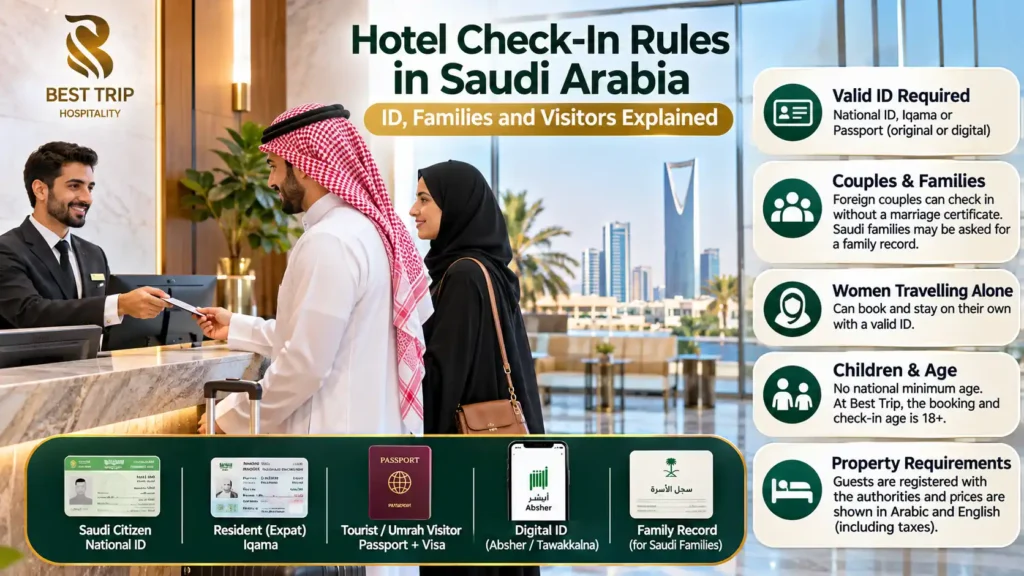
To check in to a hotel or serviced apartment in Saudi Arabia, every guest needs a valid original ID. Saudis use a national ID, residents use their Iqama, and visitors use a passport. Digital identity approved by the Ministry of Interior is also accepted. Since October 2019, foreign couples do not need a marriage certificate and women can check in alone with their own ID. Saudi nationals checking in together may be asked for a family record. Properties must register every guest with the authorities and show prices in Arabic and English, including taxes.
Check-in rules in Saudi Arabia used to be a common worry for travellers. Many still search for old advice about marriage certificates or male guardians that no longer applies. The rules changed significantly in 2019, and the Ministry of Tourism now publishes clear guidance on what guests must show and what properties must provide in return.
This guide sets out who needs which document, how the rules work for couples, families and women, what properties are allowed to ask for, and what to expect at the desk. It also explains how our reception teams at Best Trip Hotels handle check-in day to day at our serviced apartments in Jeddah and Jazan.
Check-In Documents at a Glance
The Ministry of Tourism states that its accommodation rules apply equally to citizens, residents and foreign tourists, without any distinction between men and women. What changes from guest to guest is the document you show.
| Guest | Main document at check-in | Also accepted | Points to note |
|---|---|---|---|
| Saudi citizen | National ID card | Digital ID through Absher or Tawakkalna | Saudi couples or families may be asked for a family record |
| Resident (expat living in Saudi Arabia) | Iqama (residence permit) | Digital Iqama through Absher | Make sure the Iqama is valid on the day |
| Tourist on an e-visa or visa on arrival | Passport with valid visa | Digital visitor ID, where issued | The name must match your booking |
| Umrah visitor | Passport with Umrah visa | Digital visitor ID, where issued | Umrah visa bookings may also be linked through Nusuk |
| GCC citizen | National ID or passport | Passport | Bring the same document you entered with |
| Children | Covered by a parent’s or guardian’s documents | Their own passport if travelling on one | Each guest should be registered |
Sources: Ministry of Tourism guest FAQ, SCTH announcement of October 2019.
What the Ministry of Tourism Requires
The Ministry’s published guidance for tourism accommodation is short and specific. Original identification documents must be shown so staff can verify them and record the details. Accepted documents are passports, national IDs and residency permits, along with digital identity approved by the Ministry of Interior.
One point surprises many guests. Properties are told not to keep copies of your documents. Staff should look at the original, record what they need and hand it back. If someone insists on photographing or holding your passport, you can ask why and, if needed, raise it with the Ministry.
There is also a safety net. In an emergency, a guest without proof of identity may still be accommodated with approval from the relevant authorities. This is meant for genuine emergencies, such as a lost passport, and it depends on that approval being given.
Couples and Families
Foreign couples
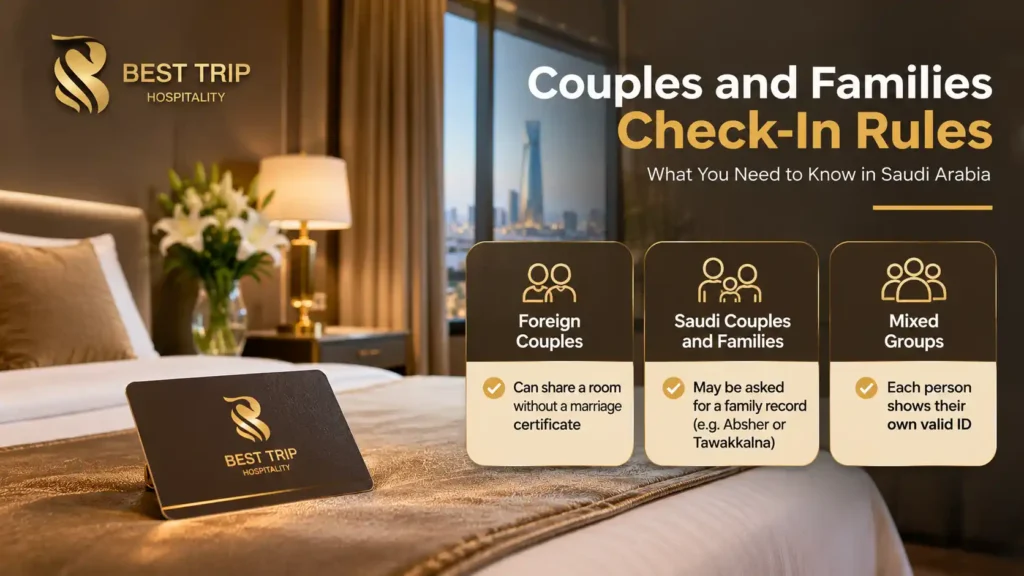
On 6 October 2019, the Saudi Commission for Tourism and National Heritage announced that foreign couples could share a hotel room without showing a marriage certificate. Each person shows their own ID, and that is all.
This applies to married and unmarried foreign couples alike. Al Jazeera, reporting the announcement, quoted the commission as saying foreign couples could stay “without the need for them to present a marriage certificate”.
Saudi couples and families
The same 2019 announcement said that Saudi nationals would be asked to show family ID or proof of relationship when checking in together. The Ministry’s current guidance lists only ID documents and says rules apply equally to everyone, but it does not cancel that earlier statement in plain words.
In practice, Saudi families should bring the family record, either on paper or in digital form through Absher or Tawakkalna. Many front desks do not ask for it, but having it on your phone avoids any delay if they do.
Mixed groups
When a group includes both Saudis and foreigners, each person shows their own document. If you are unsure what a property will ask for, message them before arrival. A short reply from reception saves a long conversation at the desk, and you can contact Best Trip Hotels the same way before any of our stays.
Women Travelling Alone
Women of any nationality, including Saudi women, can book and stay in hotels and serviced apartments on their own. The 2019 change removed the old expectation of a male guardian, and the Ministry’s guidance confirms there is no distinction between men and women.
All a woman needs is her own valid ID. She does not need a letter, a guardian’s presence or permission from anyone else. If a property tells you otherwise, it is out of line with the Ministry’s rules, and you can report it to the Unified Tourism Call Center on 930.

Age and Children
The Ministry’s guidance does not set a single national minimum check-in age. Properties set their own rules in their booking terms.
At Best Trip Hotels, the person making a reservation must be at least 18 years old, and the guest checking in must show a valid government-issued ID or passport. Children under 6 stay free when using existing beds, and extra beds or baby cots can be requested, with charges possibly applying. Maximum occupancy for each unit must be followed, so tell us in advance how many people are coming. The Best Trip services page shows what each property offers for families.
Digital ID: Can You Use Your Phone?
Yes, in most cases. The Ministry of Tourism accepts digital identity approved by the Ministry of Interior. For Saudis and residents, that usually means the digital ID or Iqama in Absher or Tawakkalna. Some visitors can also access a digital visitor ID.
It still makes sense to carry the physical document. Phone batteries die, apps sometimes ask you to log in again, and not every desk handles digital ID at the same speed. Your passport or card is the backup that always works.
What Happens to Your Details
Every hotel and serviced apartment in Saudi Arabia must register guests through Shomoos, the Ministry of Interior’s guest registration system. The system records each guest’s identity, arrival and departure.
This is a legal requirement for the property, not a choice. It is also why staff need to see every adult’s document, not just the lead guest’s. If one person in your party arrives later, they will need to show their ID when they get there.
Check-In and Check-Out Times
The regulations do not fix national check-in and check-out times. Instead, each property must publish a clear policy. The Ministry sets two firm rules around it:
- On the day of arrival and departure combined, the guest must get at least 20 hours in the unit.
- A property cannot force you to book more than one night to accept your reservation.
The Ministry’s tourist rights guide also says compensation applies if you cannot check in within two hours of the scheduled time.
At Best Trip Hotels, check-in is after 3 PM and check-out is until 2 PM. Early check-in or late check-out can be requested and depends on availability, which is often helpful for guests landing early or leaving on evening flights.
Prices, Taxes and Payment at Check-In
The Ministry requires properties to give guests a price list in both Arabic and English, with service fees, taxes and extra charges listed separately. Card payment via Visa or Mastercard must be available, and no unauthorised amounts may be taken from your card.
VAT in Saudi Arabia is 15%, and a municipality or city tax is added on top of room rates. At Best Trip Hotels, rates on our property pages are shown before VAT and city tax.
Room rates change with the season, demand and length of stay, and they rise and fall during Ramadan, school holidays and the Umrah peak. For your exact dates, check the property page or the booking engine on our website. Our monthly properties, Best Trip City Zone and Best Trip Istanbul, arrange monthly terms directly with each guest rather than showing fixed prices.
Deposits are allowed, but the Ministry asks properties to explain their deposit refund timelines in their policies. Properties also cannot ask for payment after you have checked out and the invoice has been closed.
Your Rights as a Guest
The Ministry’s tourist rights guide is worth knowing before you travel. Among other things, a property cannot force you to leave your unit after check-in except through the relevant authorities. You are entitled to a reservation document showing the booking date, length of stay, prices and cancellation terms.
You can call the Unified Tourism Call Center on 930 if:
- the quality of service falls short during your stay,
- a staff member refuses service without a valid reason,
- your luggage or belongings are held for any reason,
- maintenance work causes noise that disturbs you.
Every licensed property must also display its Ministry of Tourism licence at reception. If you cannot see it, ask.
Visitors to Your Room
Rules for day visitors are set by each property rather than by a national rule, and they vary. Some properties ask visitors to register at reception, some limit visiting hours, and some allow visitors only in lobbies or shared areas.
If you expect family or colleagues to visit, ask reception on arrival what the policy is. It avoids awkward moments later, especially late in the evening.
Practical Tips for a Smooth Check-In
A few small habits make check-in faster, whatever the property.

Book in the exact name shown on your ID. A missing middle name or a different spelling can slow things down, especially for guests whose passports use a different script from their booking. Have every adult’s ID ready, not just the lead guest’s, because each person must be registered.
If you are arriving late at night, tell the property your arrival time. If you are arriving early, ask about early check-in or luggage storage before you land. And if you are a Saudi family travelling together, keep the family record on your phone through Absher or Tawakkalna.
How Check-In Works at Best Trip Hotels
Best Trip Hotels runs serviced apartments and a hotel across Jeddah and Jazan, and every property follows the same check-in process. Our 24-hour reception teams verify the original ID of each adult guest, register the stay through the official systems and hand the documents straight back.
We accept cash on arrival and credit cards. For card bookings, your card may be pre-authorised or charged depending on the rate you chose. Cancellations made at least 24 hours before check-in are eligible for a full refund if you paid in advance, while later cancellations carry a fee equal to one night. Smoking is not allowed indoors, and pets are only allowed with prior approval. The full details are in our Best Trip terms and conditions.
If you are not sure which type of stay suits your trip, our explainer on what is a serviced apartment covers what is included, and our comparison of serviced apartment vs hotel looks at space, service and cost side by side.
Pilgrims planning a base in the city can read our guide to staying in Jeddah for Umrah, and first-time visitors can compare districts in our guide on where to stay in Jeddah.
Every location, from Jeddah to Jazan, is listed under Best Trip Hotels.
Frequently Asked Questions
What documents do I need to check in to a hotel in Saudi Arabia?
A valid original ID. Saudis use a national ID, residents use an Iqama and visitors use a passport. Digital identity approved by the Ministry of Interior is also accepted.
Can unmarried couples stay in a hotel in Saudi Arabia?
Foreign couples can share a room without a marriage certificate, a rule in place since October 2019. Saudi nationals checking in together may be asked for a family record or proof of relationship.
Can a woman check in to a hotel alone in Saudi Arabia?
Yes. Women of any nationality, including Saudis, can check in alone with their own valid ID. No guardian is required.
Can I check in with my Absher or Tawakkalna digital ID?
Usually, yes. The Ministry of Tourism accepts digital identity approved by the Ministry of Interior. Carry your physical card or passport as a backup.
Can a hotel keep a copy of my passport?
The Ministry’s guidance says properties must verify original documents and record the details, but may not keep copies.
What is the minimum age to check in?
There is no single national age in the Ministry’s guidance. Each property sets its own rule. At Best Trip Hotels, the person making the reservation must be at least 18.
Who do I contact if a hotel breaks the rules?
Call the Unified Tourism Call Center on 930.
Leave a Reply