
 العربية


Jeddah is one of Saudi Arabia’s main medical centres, with large hospitals such as King Faisal Specialist Hospital and Research Centre, Dr. Soliman Fakeeh Hospital, International Medical Center, Saudi German Hospital and King Abdulaziz University Hospital. Choose where you stay by your hospital’s location, because traffic between districts can be heavy. For treatment that lasts more than a few days, an apartment with a kitchen, a washing machine and a separate room for companions usually works better than a hotel room.
Families travel to Jeddah every week for surgery, specialist consultations, follow-up care and long courses of treatment. Many come from other Saudi regions, and many from abroad. The medical side is usually arranged by the hospital. The practical side, such as where to stay, how to get to appointments and how to keep a family comfortable for weeks, is often left to the patient.
That second part is what this guide covers. It brings together the main hospitals and where they are, the basics of insurance and emergencies for visitors, and what we have learned from hosting patients and their companions at Best Trip Hotels, including at Best Trip City Zone, which sits a short walk from Jeddah National Hospital.
Major Hospitals in Jeddah and Where They Are
Jeddah stretches a long way along the coast, so the first question is not which district is nicest but which hospital you will visit most. The table lists major hospitals, the location details their published sources give, and the nearby areas visitors usually consider.
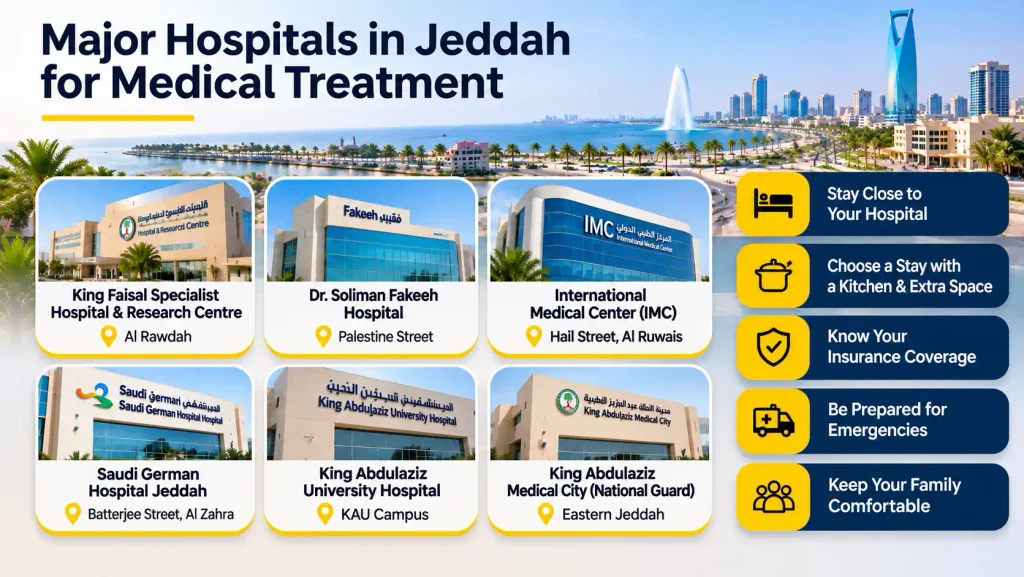
| Hospital | Type | Location detail | Nearby areas to consider |
|---|---|---|---|
| King Faisal Specialist Hospital and Research Centre, Jeddah | Government specialist, about 500 beds | Listed in Al Rawdah | Al Rawdah, Al Zahra, Al Salamah |
| Dr. Soliman Fakeeh Hospital | Private, founded 1978 | Palestine Street | Central districts near Palestine Street |
| International Medical Center (IMC) | Private, about 300 beds, JCI accredited | Hail Street, Al Ruwais | Al Ruwais, Al Rawdah |
| Saudi German Hospital Jeddah | Private, about 218 beds, opened 1988 | Batterjee Street, Al Zahra | Al Zahra, An Nuzhah |
| King Abdulaziz University Hospital | University hospital, over 1,000 beds | King Abdulaziz University campus | Al Rawabi, Al Sulaymaniyah, Al Jamiah |
| King Abdulaziz Medical City (National Guard) | Government, about 751 beds | Eastern Jeddah | Check eligibility first |
| King Fahad Hospital Jeddah | Ministry of Health, opened 1980 | Confirm with the hospital | Ask the hospital for directions |
| Jeddah National Hospital | Private | Near King Fahad Road, An Nuzhah | An Nuzhah |
Bed numbers and founding years come from Wikipedia, Saudipedia, the Ministry of National Guard Health Affairs and AllocationAssist. Street details come from the US Consulate’s list of medical facilities in Jeddah. Always confirm details directly with the hospital, as beds, departments and contact numbers change.
Note: IMC’s main hospital is on Hail Street, Al Ruwais; its First Clinic outpatient clinic is at Etoile Center, King Abdulaziz Road, Al Zahra.
Other private hospitals listed by the US Consulate include Dr. Erfan and Bagedo General Hospital on Prince Fahd Street, GNP Hospital on Prince Sultan Street and United Doctors Hospital on the Corniche.
Choosing Where to Stay Near Your Hospital
Once you know your hospital, pick a base within 10 to 15 minutes of it if you can. Daily appointments, early fasting tests and late results all become easier when the drive is short.
If your hospital is in the north, near the airport, An Nuzhah is the obvious fit. Our An Nuzhah, Jeddah guide covers the district’s malls, roads and services in detail, and Jeddah National Hospital sits right beside it.
For King Abdulaziz University Hospital, the eastern side of the city makes more sense. Al Rawabi, Jeddah borders the university area and has its own clinics, supermarkets and pharmacies, which helps on long stays.
For hospitals in Al Ruwais and Al Rawdah, such as IMC, Saudi German Hospital and King Faisal Specialist Hospital, central and north-central districts keep journeys short.
Why a Kitchen and Extra Space Matter
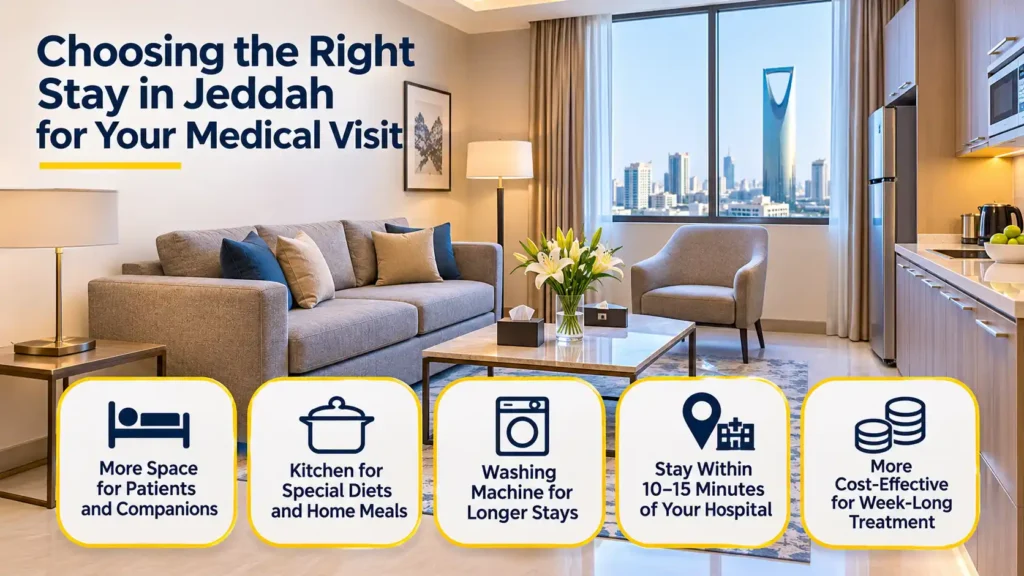
Treatment trips are rarely like holidays. Patients may be on special diets, recovering from surgery or tired after long sessions. Companions need somewhere to rest, wash clothes and sometimes work. A single hotel room fills up fast under those conditions.
A kitchen lets you prepare the meals doctors recommend instead of relying on takeaways. It also saves money over weeks, which matters when treatment costs are already high. A washing machine means you can pack less and keep hospital clothes fresh. A separate bedroom or living area lets one person sleep while another sits up with paperwork or calls home.
This is why many medical visitors choose serviced apartments rather than hotels. If the idea is new to you, our explainer on what is a serviced apartment sets out what is usually included.
Insurance and Paying for Care
How you pay depends on whether you are a resident, a visitor or a referred patient.
Visitors on a Saudi tourist e-visa receive basic health insurance as part of the visa fee. It covers emergency medical expenses up to SAR 100,000 but does not cover pre-existing conditions or routine check-ups. Routine dental work is not covered, but emergency dental treatment is covered up to SAR 500. It is not designed for planned treatment.
For planned treatment, most private hospitals ask for payment or a guarantee in advance. The amount varies by hospital, so confirm the deposit or guarantee required with the hospital before admission. Private hospitals usually accept Visa, Mastercard and Mada. Prices vary widely by hospital and procedure, so ask for a written estimate before you travel.
Some hospitals have international patient teams that help with visas, airport transfers and accommodation. Saudi German Hospital Jeddah offers these services. Contact your hospital’s patient office early and ask exactly which services it provides before you travel.
Emergencies and Urgent Care
In an emergency in Jeddah, call 997 for the Saudi Red Crescent ambulance service. The Makkah region also uses the unified emergency number 911.
Keep these with you at all times during a treatment trip:
- The patient’s passport or ID, and the companion’s.
- Insurance documents and any hospital referral letters.
- A list of current medicines with doses.
- Your hospital’s emergency and patient office numbers.
- The address of where you are staying, written in Arabic and English.
Planning a Treatment Trip Step by Step
Good planning removes most of the stress from a medical trip.
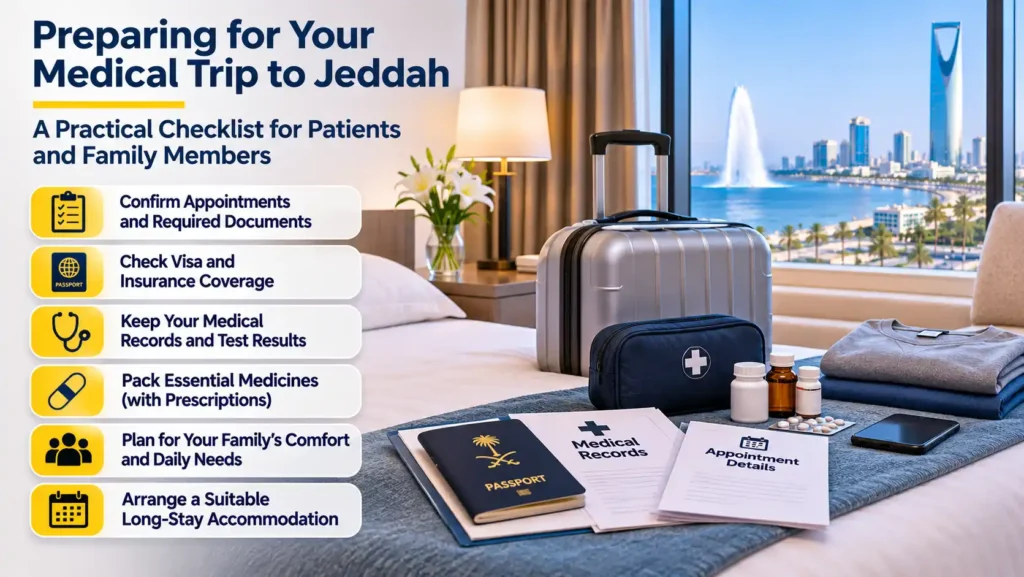
- Confirm the appointment and treatment plan in writing, including how long you are likely to stay.
- Ask the hospital which visa and documents you need, and whether they provide an invitation or support letter.
- Check insurance cover and get a written cost estimate.
- Book accommodation near the hospital with flexible dates, as treatment plans often change.
- Arrange transport for the first day. A ride app works for most trips, but some patients need a car with space for a wheelchair.
- Bring medical records and recent test results in a folder and on your phone.
Getting to Appointments
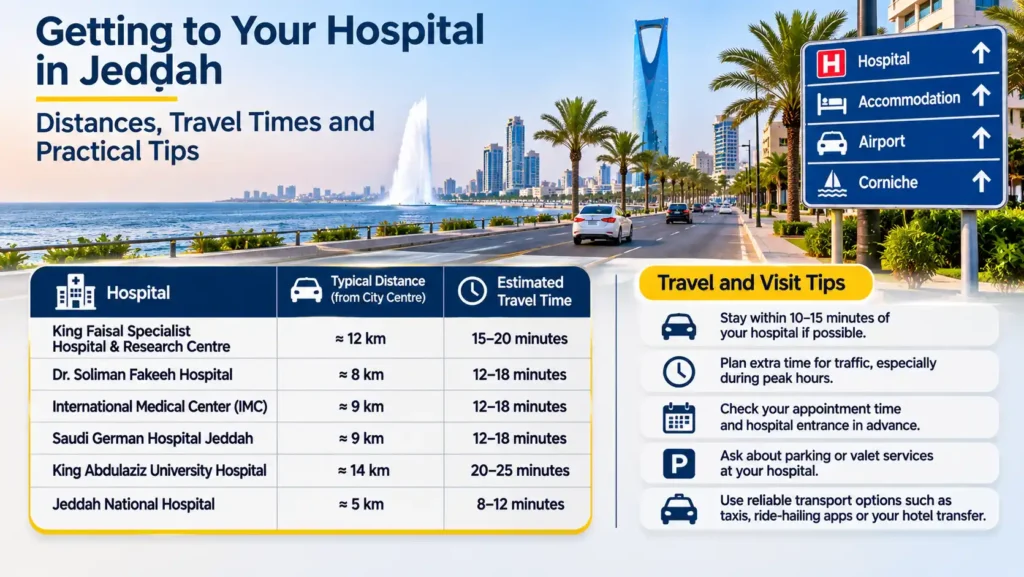
Uber and Careem are the easiest way to move between your stay and the hospital. Allow extra time for morning appointments, as traffic builds from about 7 AM, and again in the late afternoon. If a patient cannot walk far, ask the driver to use the hospital’s main drop-off point rather than the street.
Some families rent a car for long stays. Hospital car parks fill up early, so arrive ahead of your appointment time. Free parking where you stay helps, because you can keep the car close without daily fees.
Traffic patterns differ a lot between the north, centre and east of the city. Our guide on where to stay in Jeddah compares each main area, which helps if your appointments are spread across more than one hospital.
Tips for Companions
Companions often carry the heaviest load on a treatment trip. A few habits help.
Keep a simple notebook or phone note of every appointment, test and result. Take turns at the hospital if more than one companion is travelling, so everyone gets proper sleep. Use quiet hours at your apartment to cook simple meals for the next day, and keep easy snacks and water ready for long waits.
Do not forget your own health. Walk outside in the cooler evening hours, eat properly and stay in touch with family at home. A calm base to return to every evening makes a real difference over weeks.
Check-In Documents for Patients and Families
When you arrive, every adult will need to show an original ID. Saudis use a national ID, residents use an Iqama and visitors use a passport. Saudi families checking in together may be asked for a family record. Our guide to hotel check-in requirements in Saudi Arabia explains the rules in full.
Hotel, Serviced Apartment or Furnished Flat?
For a stay of one or two nights around a short procedure, a hotel can work well. For a week or more, a serviced apartment usually gives better space and value, with a reception team on hand. A private furnished flat may be cheaper for months but comes with less support and a different kind of contract.
Our comparison of serviced apartment vs hotel breaks down the space and cost differences, and our guide to hotel apartment vs furnished apartment explains what each label really means in Saudi Arabia.
Stay Close to Your Hospital With Best Trip Hotels
Treatment is stressful enough without long drives, cramped rooms and takeaway meals. Best Trip Hotels runs serviced apartments across Jeddah, and our teams host patients and their families throughout the year. Here is how we can help.
Best Trip City Zone, next to Jeddah National Hospital
City Zone sits on King Fahad Road in An Nuzhah, about 290 m from Jeddah National Hospital and around 8 minutes from the airport. It is our dedicated monthly property, built for long stays. Apartments range from studios to two-bedroom units, each with a full kitchen and a separate living area, and a washing machine is available on request. Monthly terms are arranged directly with reception or head office.
Best Trip Istanbul, near the university hospital side of the city
Best Trip Istanbul in Al Rawabi is our second monthly property, on the eastern side of Jeddah near the King Abdulaziz University area. It offers studios, one-bedroom and two-bedroom apartments with separate living rooms and equipped kitchenettes, close to LuLu Hypermarket and local markets. Monthly terms are agreed directly with the property.
What every Best Trip stay includes
- A reception desk open 24 hours, useful for late returns from hospital.
- Free Wi-Fi and free parking at every branch.
- Daily housekeeping.
- Check-in from 3 PM and check-out by 2 PM, with early or late times on request, subject to availability.
Rates and booking
Rates for our daily properties change with the season, demand and length of stay, and they rise and fall during Ramadan, school holidays and the Umrah peak. Check the property page or the booking engine on our website for your exact dates. For City Zone and Istanbul, contact the property for a monthly quote based on your treatment plan.
Tell us your hospital, your expected dates and how many people are travelling, and our team will suggest the branch and unit that fit best. You can browse all our serviced apartments in Jeddah and book directly, or message us on WhatsApp for help planning a stay around your treatment.
Frequently Asked Questions
Which are the main hospitals in Jeddah for specialist treatment?
Major options include King Faisal Specialist Hospital and Research Centre, Dr. Soliman Fakeeh Hospital, International Medical Center, Saudi German Hospital and King Abdulaziz University Hospital. Your doctor or insurer will usually guide the choice.
Where should I stay in Jeddah for hospital treatment?
Stay as close as possible to your main hospital. An Nuzhah suits Jeddah National Hospital and the north, Al Rawabi suits King Abdulaziz University Hospital, and central districts suit hospitals in Al Ruwais and Al Rawdah.
Does Saudi tourist visa insurance cover planned treatment?
No. The basic insurance included with the tourist e-visa is for emergencies and does not cover pre-existing conditions or routine care. Arrange separate cover or payment for planned treatment.
What is the emergency number in Jeddah?
Call 997 for the Saudi Red Crescent ambulance service. The unified emergency number 911 also operates in the Makkah region.
Is a serviced apartment better than a hotel for a treatment stay?
For stays of a week or more, usually yes. A kitchen, a washing machine and separate rooms make long treatment trips easier for patients and companions.
Can I stay monthly near a Jeddah hospital?
Yes. Monthly serviced apartments, such as Best Trip City Zone and Best Trip Istanbul, offer furnished units with services included and terms agreed directly with the property.
Leave a Reply