
 العربية


Hotel stays in Saudi Arabia carry two charges on top of the room rate: 15% VAT, collected for the Zakat, Tax and Customs Authority (ZATCA), and a municipality fee, often called city tax, of 2.5% for three-star and lower-graded properties or 5% for higher grades. At Best Trip Hotels, rates are shown before both, with 15% VAT and 2.5% city tax added. A room listed at SAR 132 a night comes to about SAR 155 with taxes.
Many guests are surprised when the final bill at a Saudi hotel is higher than the price they first saw. In most cases nothing is wrong. The difference is tax, and once you know how it works, comparing prices becomes much easier.
This guide explains both charges, where they come from and how they appear on your invoice. It also walks through the maths on a real nightly rate from one of our properties, so you can see exactly what a stay costs. At Best Trip Hotels, we show rates before tax on every property page, and this is the question our reception teams answer most often at check-in.
The Two Charges on a Saudi Hotel Bill
Every licensed hotel, hotel apartment and serviced apartment in Saudi Arabia adds the same two items to the room rate.
| Value Added Tax (VAT) | Municipality fee (city tax) | |
|---|---|---|
| Rate | 15% | 2.5% or 5%, depending on category |
| Collected for | ZATCA | The municipal authorities |
| In place since | 5% from 2018, 15% from 1 July 2020 | February 2018 |
| Applies to | Room charges and most other hotel services | Occupied rooms |
| Shown on invoice | Yes, as a separate line | Yes, as a separate line |
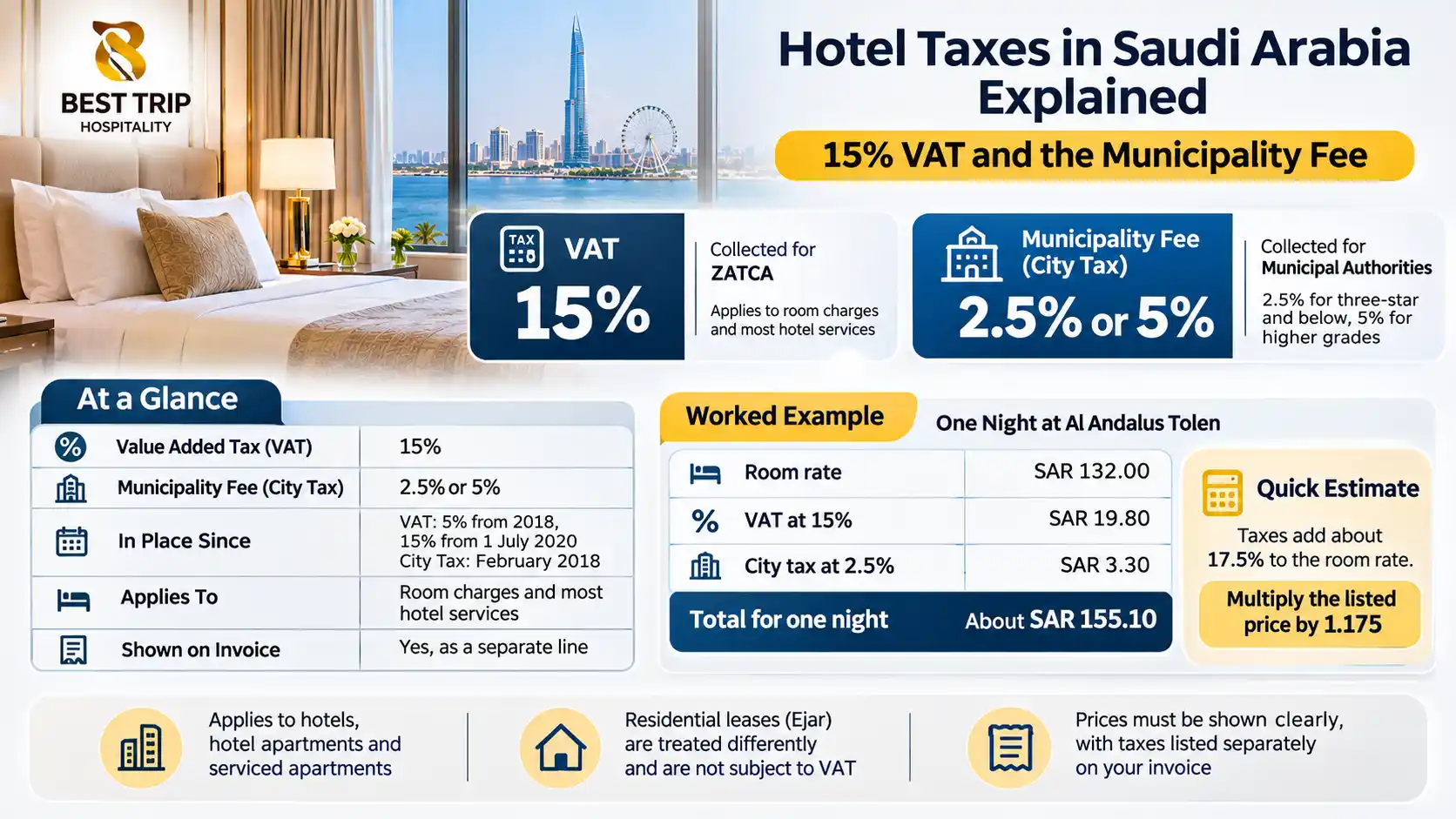
Neither charge is a hotel’s own fee. The property collects them from guests and pays them on to the authorities.
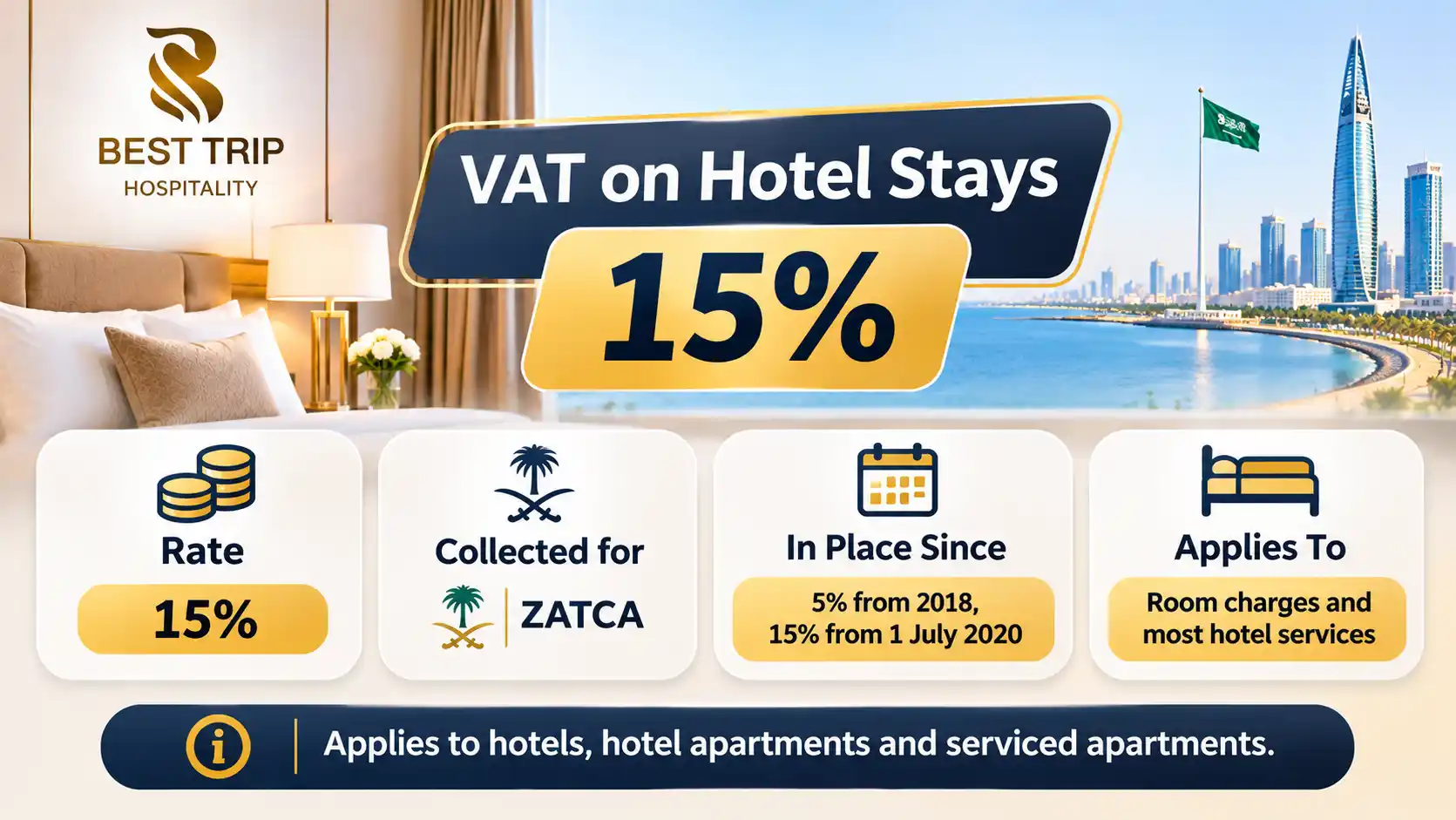
VAT on Hotel Stays: 15%
Saudi Arabia introduced VAT at 5% in January 2018 and raised the standard rate to 15% from 1 July 2020, as Deloitte and other advisers reported at the time. Hotel accommodation is charged at this standard rate.
This applies to hotels, hotel apartments and serviced apartments alike. Under ZATCA’s guideline for the real estate sector, accommodation provided to visitors and travellers, including serviced accommodation, is not treated as a residential home. Dariba, summarising ZATCA’s May 2026 guideline, notes that even a four-month stay in serviced apartments is taxable because the unit is not leased for regular residence.
The exemption you may have heard of applies to residential leases, meaning a flat rented as someone’s home. That is why a long Ejar lease on a furnished flat is treated differently from a monthly stay in a serviced apartment. Our guide to hotel apartment vs furnished apartment explains how those two kinds of stay are licensed and contracted.
The Municipality Fee, or City Tax
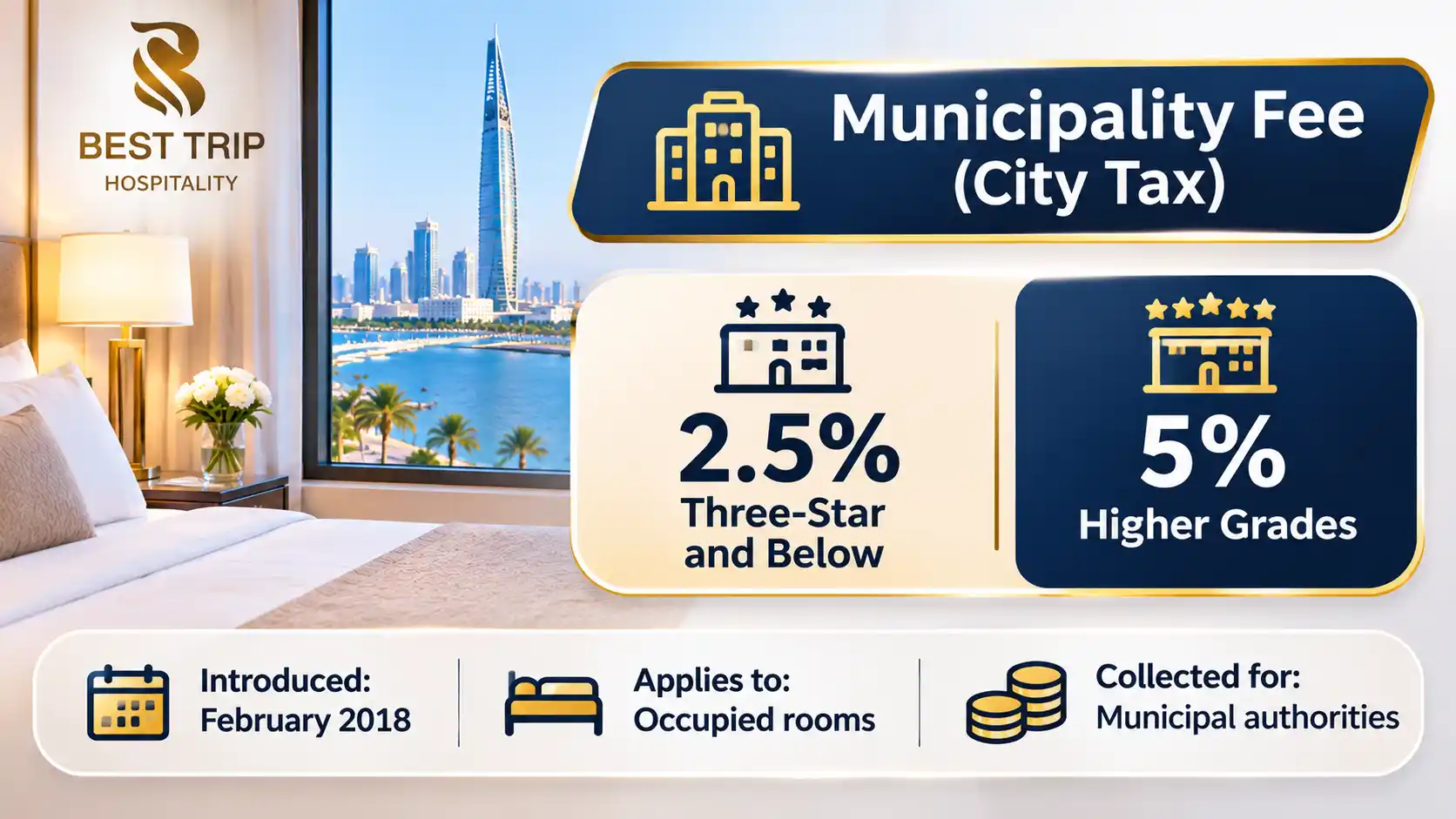
The second charge is the municipality fee. Most guests know it as city tax, and that is how it appears on Best Trip Hotels property pages.
It was introduced in February 2018 by the Ministry of Municipal and Rural Affairs. Saudi Gazette reported at the time that the fee applied to “each room occupied in hotels and furnished apartments across the Kingdom”, at a standard rate of 5%, with a reduced rate of 2.5% for three-star hotels and below. Hotels collect it from guests and pay it to the ministry each month.
The fee only applies to occupied rooms, and the rate depends on the property’s classification. That is why two properties in the same street can show different tax lines on their invoices.
At every Best Trip Hotels property with published nightly rates, the city tax is 2.5%.
Worked Example: A Real Best Trip Nightly Rate
The clearest way to understand hotel tax is to run the numbers on a real price. The rates below come from our property pages as checked in November 2026.
One night in a studio at Al Andalus Tolen
Al Andalus Tolen in Al Baghdadiyah lists its 30 m² Studio at SAR 132 per night, plus 15% VAT and 2.5% city tax.
| Line | Amount |
|---|---|
| Room rate | SAR 132.00 |
| VAT at 15% | SAR 19.80 |
| City tax at 2.5% | SAR 3.30 |
| Total for one night | About SAR 155.10 |
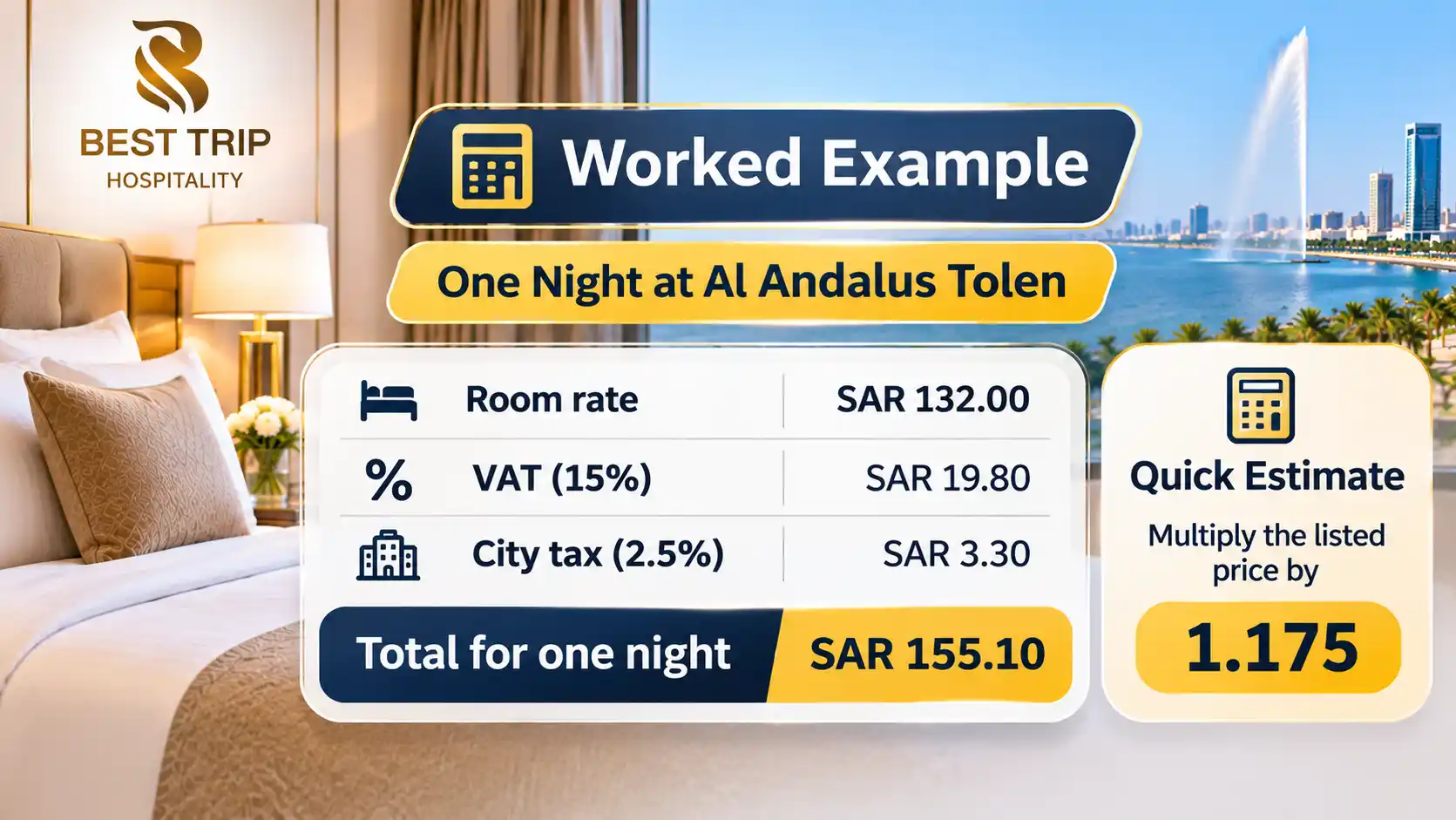
In simple terms, the taxes add about 17.5% to the room rate, so a quick way to estimate is to multiply the listed price by 1.175.
Seven nights in a two-bedroom at Best Trip Paris
For a family trip, Best Trip Paris in An Nuzhah lists its 90 m² Two Bedroom Apartment at SAR 162 per night.
- Room rate for 7 nights: SAR 1,134.00
- VAT at 15%: about SAR 170.10
- City tax at 2.5%: about SAR 28.35
- Total: about SAR 1,332.45
A note on how the taxes are calculated
The examples above apply both charges to the room rate. Some systems apply VAT to the room rate plus the municipality fee, which adds a few riyals more. On the one-night studio example, that method gives about SAR 155.60 instead of SAR 155.10. Your invoice will always show the exact figures for your stay.
Rates also change with the season, demand and length of stay, and they rise and fall during Ramadan, school holidays and the Umrah peak. Treat these examples as a guide to how tax works, not as a price for your dates.
How Prices Should Be Shown to You
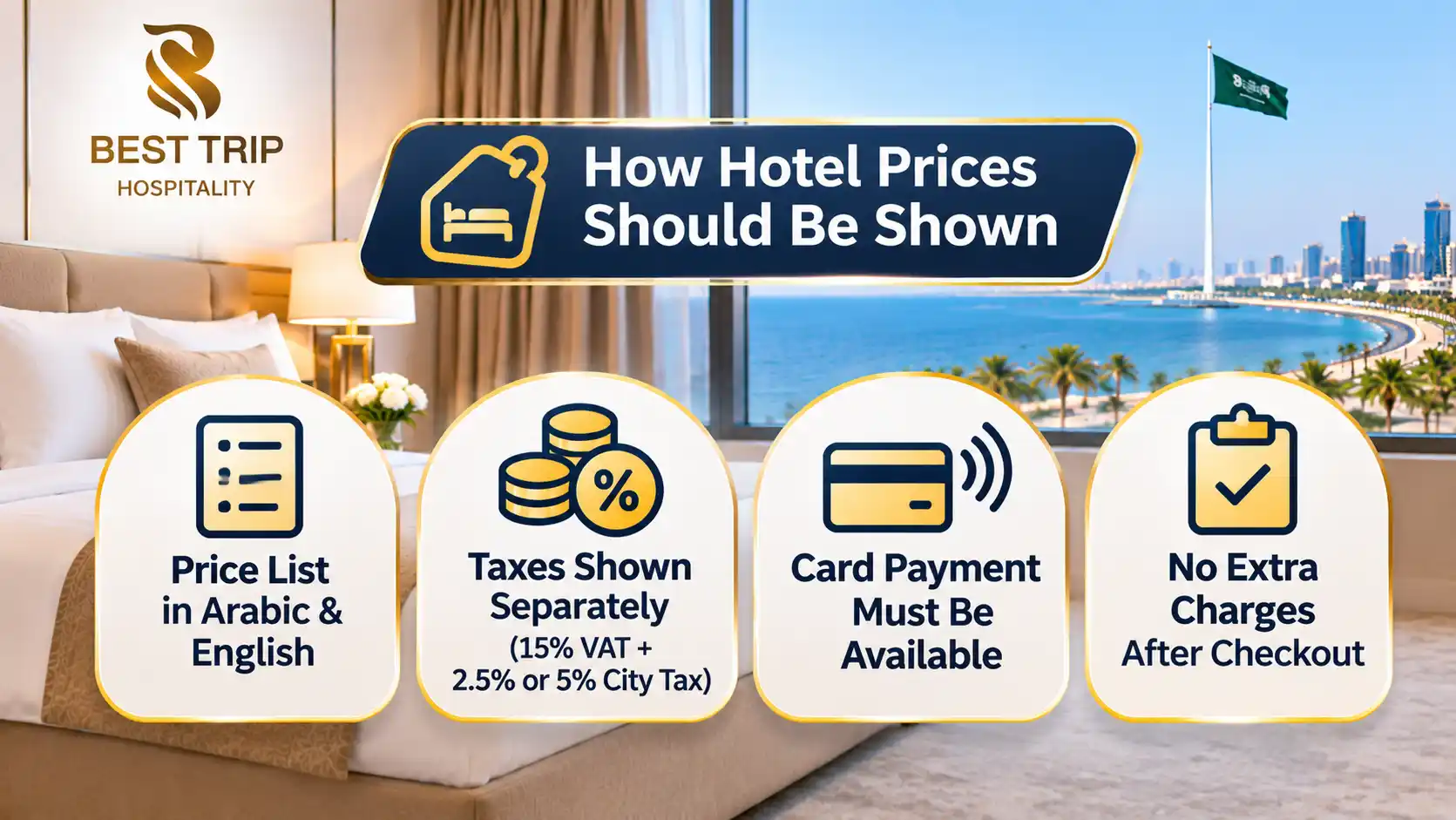
The Ministry of Tourism requires licensed properties to give guests a price list in both Arabic and English, with service fees, taxes and extra charges listed separately. Card payment must be available, and properties cannot add charges after you have checked out and the invoice has been closed.
Booking sites handle tax in different ways. Some show the room rate first and add tax at the final step, while others show the total from the start. When you compare two properties, make sure you are comparing the same thing: either both rates before tax or both totals with tax.
If a seller cannot tell you clearly what taxes apply, or offers a “no tax” price for cash, be careful. A licensed property must charge VAT and the municipality fee. Our guide on how to check a hotel license in Saudi Arabia shows how to confirm a property is properly registered before you pay.
Reading Your Hotel Invoice
Since 4 December 2021, VAT-registered businesses in Saudi Arabia have had to issue electronic invoices under ZATCA’s Fatoora system. For guests, that usually means a simplified tax invoice with a QR code.
A proper hotel invoice should show:
- The property’s name and VAT registration number.
- The date and time of issue.
- Your dates of stay and the room rate.
- The VAT amount as a separate line.
- The municipality fee as a separate line.
- The total amount paid.
- A QR code containing the key invoice details.
Keep your invoice, especially for business travel. Companies usually need it for expense claims and, where they are VAT-registered themselves, for their own tax records. Our guide to hotel check-in requirements in Saudi Arabia also covers what properties must give you in writing during your stay.
Business Travellers and Company Invoices
If your company is paying for the stay, the invoice matters as much as the price. Many Saudi companies are VAT-registered and need a valid tax invoice to record the VAT they paid.
Before you check out, ask reception whether the invoice can show your company’s name and, if needed, its VAT number. Do this at check-in rather than at the last minute, so the invoice is issued correctly the first time. Changing an invoice after it has been closed is often harder than getting it right at the start.
For long assignments, ask for a single invoice covering the whole stay or one invoice per month, whichever your finance team prefers. Either way, the VAT and municipality fee should appear as separate lines, so your accounts team can see exactly what was charged.
If several colleagues are staying, agree in advance whether each person receives their own invoice or one combined invoice is issued to the company.
Monthly and Long Stays
A common question is whether VAT still applies if you stay for a month or more. For serviced apartments and hotel apartments, the answer is usually yes, because ZATCA treats visitor accommodation as taxable no matter how long the stay lasts.
Monthly stays are often priced as a single monthly amount rather than nightly rates, and the tax lines are calculated on that amount. At Best Trip Hotels, Best Trip City Zone in An Nuzhah and Best Trip Istanbul in Al Rawabi are our dedicated monthly properties. Monthly terms are agreed directly with each property, so ask reception to include the tax breakdown when they send your quote.
Charges That Are Not Taxes
Not every extra on a bill is a tax. These are set by the property, not the government, and should be explained before you book or when you request them:
- Early check-in or late check-out, which at Best Trip Hotels depends on availability and may carry a charge.
- Extra beds or baby cots, available on request, with charges possibly applying.
- Cancellation fees, which at Best Trip Hotels equal one night’s stay if you cancel less than 24 hours before check-in.
- Deposits or card pre-authorisations, depending on the rate and payment method you choose.
VAT is usually added to these service charges too, because they are part of the hotel’s supply to you.
Budgeting for a Trip
Tax adds roughly a sixth to the room cost, which matters most on long or family trips. For a week-long family stay, it can add a few hundred riyals to the total.
The simplest approach is to work out the full total, with tax, before you compare. Apartments with a kitchen can also bring down food costs, which often matters more than the tax itself. Our comparison of serviced apartment vs hotel shows how space, food and tax add up over a longer stay.
Book With Clear Pricing at Best Trip Hotels
Surprises on the final bill are the last thing you need at the end of a trip. At Best Trip Hotels, every property page shows the nightly rate before tax, with the 15% VAT and 2.5% city tax clearly listed underneath, so you know what to expect before you arrive.
Our properties cover the main parts of Jeddah and Jazan:
- An Nuzhah, near the airport: Best Trip Paris for daily stays and Best Trip City Zone for monthly stays.
- Al Baghdadiyah, near the old town: Al Andalus Tolen, with studios, suites and apartments.
- South Jeddah: Best Trip Marsilia and Best Trip Milano for families.
- East Jeddah: Best Trip Istanbul for monthly stays.
- Jazan: Best Trip Valencia near the North Corniche.
Every stay includes a 24-hour reception, free Wi-Fi, free parking and a proper invoice for your records. Rates change with the season, so check the property page for your dates, use our book now page to search availability across all branches, or browse our serviced apartments in Jeddah and book direct.
Frequently Asked Questions
How much is hotel tax in Saudi Arabia?
Hotel stays carry 15% VAT plus a municipality fee of 2.5% or 5%, depending on the property’s category. At Best Trip Hotels, the total added is 17.5% (15% VAT and 2.5% city tax).
What is city tax on a Saudi hotel bill?
City tax is the municipality fee introduced in February 2018. It is charged on occupied rooms at 2.5% for three-star and lower-graded properties and 5% for higher grades.
Is VAT charged on serviced apartments in Saudi Arabia?
Yes. Serviced apartments, hotel apartments and hotels are all charged 15% VAT. Only residential leases used as a home are exempt.
Do I pay VAT on a monthly stay?
Usually yes, if the stay is in a hotel, hotel apartment or serviced apartment. ZATCA treats visitor accommodation as taxable regardless of length.
How do I calculate the total price of a hotel room with tax?
For a property charging 15% VAT and 2.5% city tax, multiply the room rate by about 1.175. A SAR 132 room comes to about SAR 155 per night.
Why do two hotels show different tax amounts?
Because the municipality fee depends on classification. Higher-graded properties charge 5%, while three-star and lower-graded properties charge 2.5%.
Leave a Reply