
 العربية


You own a building that could work as a hotel or serviced apartments. The next question is not only who will run it, but on what terms. The model you choose decides who takes the risk, who makes the key decisions and how you get paid.
This guide compares the three main models in plain language, with a worked example and a checklist of questions. It is written by the team at Best Trip Hotels, which runs hotels and serviced apartments for owners in Jeddah and Jazan. For a wider look at what operators do day to day, see our guide to choosing a hotel management company in Saudi Arabia.
The Three Models at a Glance
| Management contract | Lease | Franchise | |
|---|---|---|---|
| Who runs the business | Operator, for the owner | Operator, as tenant | Owner, or a manager the owner hires |
| Who takes trading risk | Owner | Operator | Owner |
| Owner’s income | Profit after costs and fees | Rent | Profit after costs and franchise fees |
| Income stability | Moves with the market | Steady, if the tenant is strong | Moves with the market |
| Owner’s control | Approval rights set in the contract | Low, limited to lease terms | High, within brand standards |
| Main cost to owner | Management fees | Lower income in strong years | Royalties, brand fees, standards |
| Brand | Operator’s or none | Operator’s or none | Franchisor’s brand |
No model is better in every case. Each trades control against risk and certainty against upside.
What Is a Hotel Management Contract?
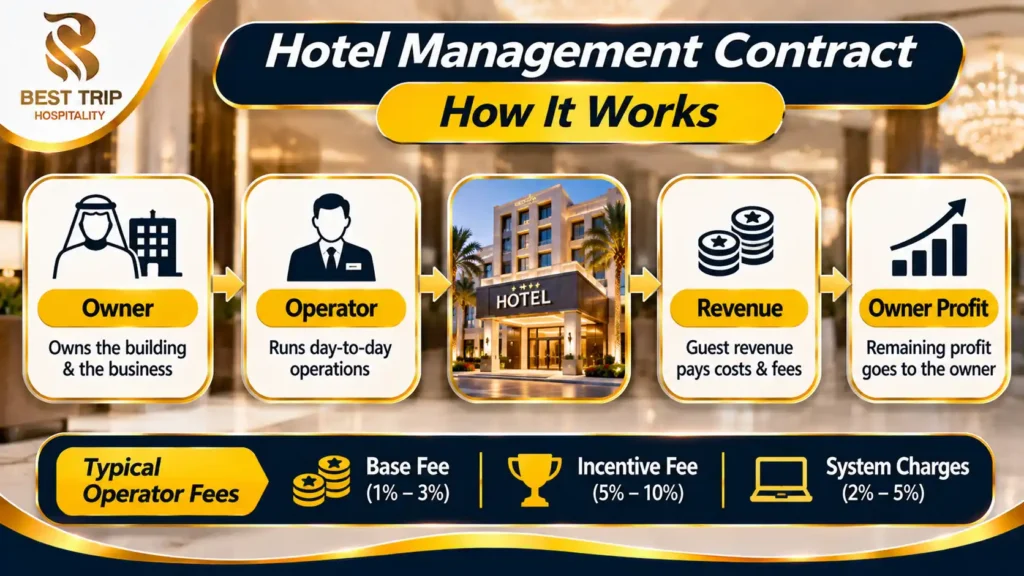
A hotel management contract, also called a hotel management agreement (HMA), appoints an operator to run the property on the owner’s behalf. The owner keeps the building, the revenue and the operating profit or loss. The operator earns fees.
How the money flows
Guest revenue belongs to the owner. Operating costs, such as staff, utilities, supplies and booking commissions, are paid from that revenue. The operator takes its fees, and what is left goes to the owner. Booking site commissions can be a large cost, which is why the channel mix matters; our guide on booking direct vs Booking.com explains the difference.
Typical fees in Saudi Arabia and the region
According to King & Spalding’s April 2025 article on Saudi hotel deals:
- Base fee: usually 1% to 3% of gross revenue in Saudi Arabia and the wider Middle East, compared with 2% to 4% globally.
- Incentive fee: a share of gross operating profit (GOP), often tiered and paid only above a threshold. Regionally, scaled incentive fees often start around 5% and can rise to 9% or 10%.
- System charges: for reservations, marketing, loyalty and technology, typically 2% to 5% of room revenue.
- Technical services fee: for pre-opening design work, typically USD 300 to USD 2,000 per key.
HVS’s September 2026 survey of Middle East and Africa agreements reported base fees commonly around 1.5% to 2.0% of revenue. These figures mainly describe branded hotels. Local independent operators structure fees in their own way.
Owner protections to look for
- Performance test. A right to end the contract if results fall below agreed targets, often measured against GOP or competing hotels.
- Owner’s priority return. A minimum return to the owner before the operator earns an incentive fee. Operators do not always accept it.
- Approval rights. King & Spalding’s January 2026 article lists common owner approvals in Saudi agreements, including budgets for flagged items, major contracts, the general manager and finance lead, insurance and the Saudization plan.
Who it suits
Owners who want the profit in good years, can absorb weaker months, and want a say in budgets and key decisions.
What Is a Hotel Lease?
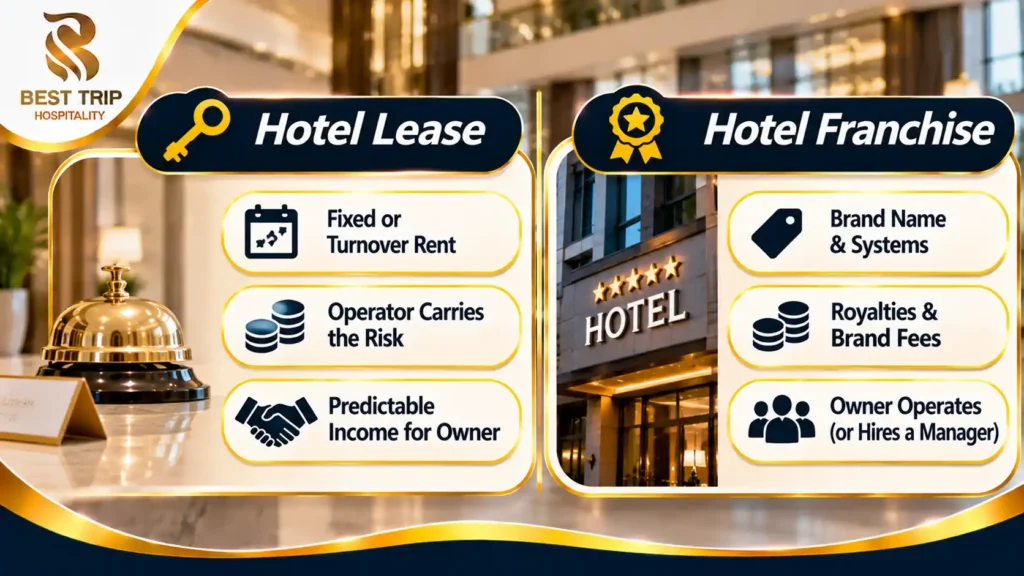
In a lease, the owner rents the building to an operator. The operator runs the hotel or apartments as its own business, keeps the profit and carries the losses. The owner receives rent.
Fixed rent and variable rent
- Fixed rent: an agreed yearly amount, usually paid in instalments and sometimes rising at set intervals.
- Variable or turnover rent: a base rent plus a share of revenue, or rent linked fully to revenue.
Lease rules in Saudi Arabia
Leases in Saudi Arabia, both residential and commercial, are registered through the Ejar platform. According to law firm Trowers & Hamlins, a lease must be registered on Ejar and follow the Unified Tenancy Contract to be enforceable through the Enforcement Courts. Their summary also notes that deposits are capped at 5% of total lease value and that leases of ten years or more must be annotated on the title deed. Owners should confirm current rules with a lawyer before signing.
Large and small leases
Long leases also appear at the top of the market. In February 2026, Al Akaria signed a 20-year lease with Amsa Hospitality for a 240-unit residential compound in Riyadh, valued at about SAR 1.2 billion, according to Arab News. Smaller buildings use the same idea on a smaller scale.
Who it suits
Owners who want predictable income, have little time for oversight, and are comfortable giving up the upside in strong years. Leases are also common for buildings let mainly to long-stay guests; our guide on how monthly apartment stays work in Saudi
Arabia shows what those guests expect.
What Is a Hotel Franchise?
A franchise lets the owner use a hotel brand’s name, booking system and standards in return for fees. The brand does not run the property. The owner runs it, or appoints a third-party manager to do so.
What the owner gets
- A known brand name and guest loyalty programme
- Access to the brand’s booking system and distribution
- Design and service standards, training and audits
What the owner pays
Franchise costs usually include an application or initial fee, ongoing royalties linked to room revenue, and contributions to marketing, reservations and loyalty programmes. The owner also funds the brand’s design and service standards, which can mean renovation before opening and upgrades over time.
Franchising in Saudi Arabia
Global brands are growing their franchise business in the Kingdom. In its September 2026 survey, HVS found that 63.6% of respondents expect more franchise agreements in the region. Brands such as IHG and Hilton continue to sign new Saudi hotels. Most franchise deals, however, involve larger hotels that meet strict brand standards.
Who it suits
Owners of larger, purpose-built hotels who want a brand and either have hotel experience or will hire a capable manager.
Revenue Share and Other Hybrid Models
Between the three main models sit several hybrids. They are common where owner and operator want to share risk.
| Hybrid model | How it works | Risk split |
|---|---|---|
| Revenue share | Owner receives an agreed percentage of revenue; operator pays costs from the rest | Shared |
| Base rent plus revenue share | Fixed minimum rent plus a share of revenue above a level | Owner protected on the downside, shares the upside |
| Management contract with guarantee | Operator guarantees the owner a minimum return | Operator carries some downside |
| “Manchise” | Starts as a management contract, converts to a franchise later | Owner takes more control over time |
A revenue share arrangement is easy to check, because revenue is simpler to verify than profit. It still depends on clear reporting and agreed definitions.
A Worked Example: The Same Building Under Three Models
The figures below are illustrative only. They show how income behaves under each model, not what any building will earn. They are not rates, offers or terms from Best Trip Hotels.
Assumptions: a 40-unit serviced apartment building, average daily rate of SAR 300, operating costs of 55% of revenue in a strong year and 60% in a weak year, a management contract with a 3% base fee and an 8% incentive fee on GOP, a fixed lease rent of SAR 900,000 a year, and a revenue share paying the owner 35% of revenue.
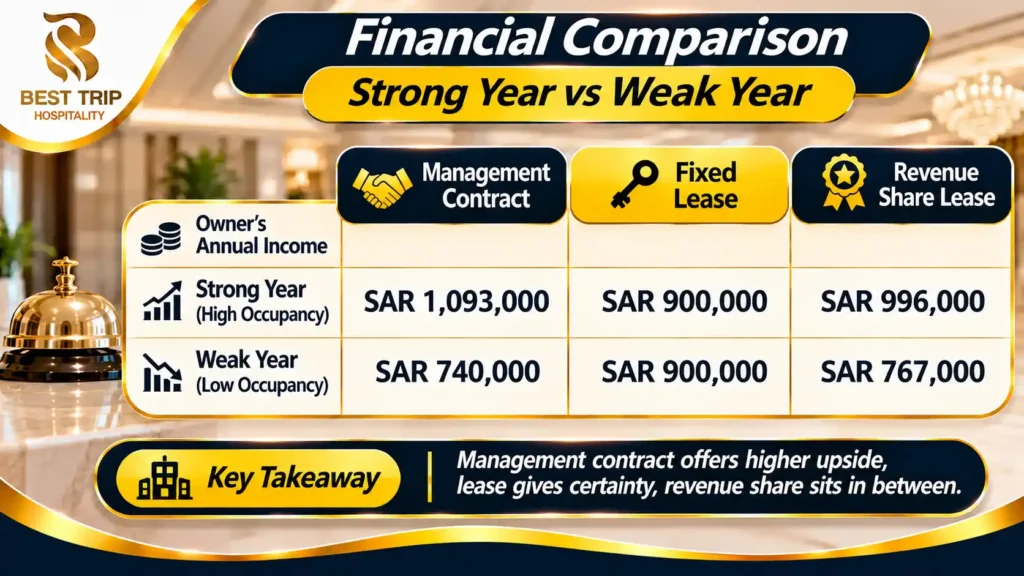
| Strong year (65% occupancy) | Weak year (50% occupancy) | |
|---|---|---|
| Room revenue | SAR 2,847,000 | SAR 2,190,000 |
| Owner income, management contract | about SAR 1,093,000 | about SAR 740,000 |
| Owner income, fixed lease | SAR 900,000 | SAR 900,000 |
| Owner income, revenue share | about SAR 996,000 | about SAR 767,000 |
What the example shows
- The management contract pays the most in a strong year and the least in a weak one.
- The lease pays the same in both years, as long as the tenant can pay.
- The revenue share sits between the two.
Real results depend on location, unit mix, demand through the year and how well the property is run. Demand in Jeddah moves sharply with Ramadan, Hajj season, school holidays and events, as our Jeddah booking calendar shows, and that affects each model differently.
Control, Risk and Income: The Key Trade-offs
Control
Under a management contract, the owner approves budgets and key appointments but leaves daily decisions to the operator. Under a lease, the owner has little say beyond the lease terms. Under a franchise, the owner controls operations, within brand standards.
Risk
The owner carries trading risk under a management contract and a franchise. Under a lease, the main risk shifts to whether the tenant can pay rent for the full term.
Income
Management contracts and franchises give a variable income. Leases give a steady one. Hybrids share both.
Capital spending
Who pays for furniture, equipment and upgrades must be written down. In management contracts and franchises, the owner usually funds them. In leases, it depends on what was agreed.
Licences, Tax and Staff Under Each Model
- Tourism licence. Hotels and serviced apartments need a Ministry of Tourism licence. Agree in writing who applies for it, whose name it is in, and who keeps it valid. Guests and owners can check a property’s status using our guide on how to check a hotel license in Saudi Arabia.
- VAT and municipality fee. Room charges carry 15% VAT and a municipality fee. Our guide to hotel taxes in Saudi Arabia explains both.
- Staff and Saudization. The employing company carries Nitaqat quotas, visas and labour obligations. In a lease, this is usually the tenant. Under a management contract, it depends on the agreement.
How to Choose: Questions for Owners
Questions to ask yourself
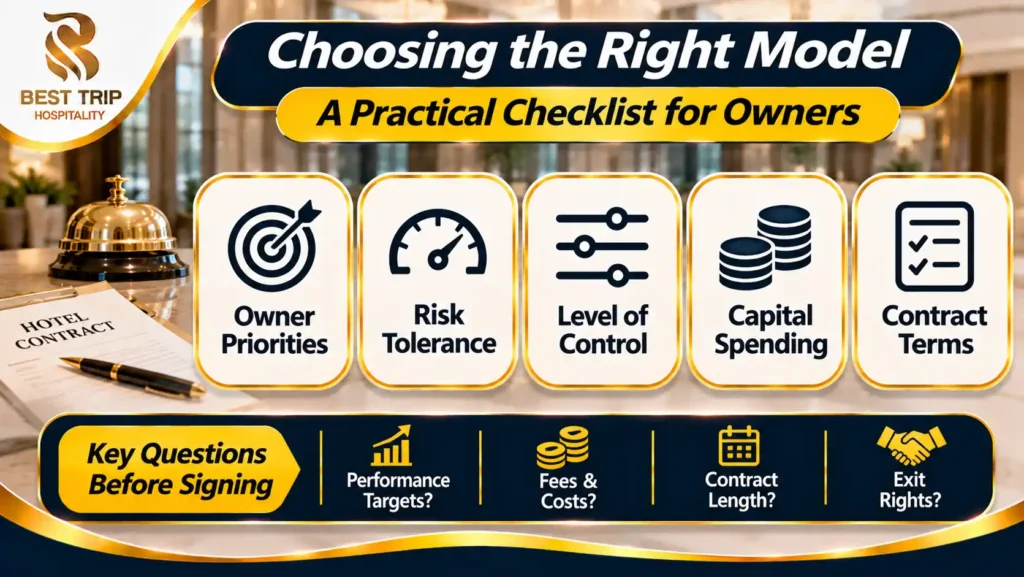
- Do I need steady income, or can I handle months that are weaker than others?
- How much time do I want to spend on oversight?
- Can I fund furniture, upgrades and repairs over the years?
- Is my building large enough, and well enough located, for a brand?
Questions to ask an operator
- Which model do you offer, and why does it suit my building?
- How is revenue reported, and how often?
- Who pays for furniture, maintenance and upgrades?
- Who holds the tourism licence?
- What happens if results fall below target?
- How long is the term, and how can either side end it?
Which Model Suits Your Building?
| Your situation | Model often worth considering |
|---|---|
| You want steady, predictable income | Lease |
| You want the upside and can handle variation | Management contract |
| You want a global brand on a large hotel | Franchise, with a manager if needed |
| You want some protection and some upside | Revenue share or base rent plus share |
| Your building suits long stays | Lease or management contract, with monthly pricing |
Buildings that suit longer stays often do well with a mix of daily and monthly units. Demand from companies also matters, and our guide to corporate housing in Jeddah explains what business tenants look for.
How Best Trip Hotels Works With Building Owners
Best Trip Hotels is a Saudi hospitality company based in Jeddah. According to our About Us page, the company has managed hotel buildings for owners under contractual agreements since 2021, when it took on Best Trip Paris.
Today we run seven properties: six in Jeddah and one in Jazan. They include a hotel, daily serviced apartment buildings and monthly properties such as Best Trip City Zone. This mix lets us advise owners on whether a building suits daily stays, monthly stays or both. Some buildings also suit companies housing staff, as covered in our guide to workforce accommodation in Jazan.
Each arrangement is agreed with the owner, property by property. We look at the building, its location, its unit mix and the owner’s goals before suggesting a structure.
We sell through several channels, including direct bookings, and plan pricing around Jeddah’s and Jazan’s busy and quiet seasons.
Frequently Asked Questions
What is the difference between a hotel management contract and a lease?
Under a management contract, the operator runs the property for the owner, and the owner keeps the profit and the risk. Under a lease, the operator rents the building, pays rent and keeps the profit and the risk.
Is a lease or a management contract better for owners?
It depends on your goals. A lease gives steadier income. A management contract can pay more in strong years but less in weak ones.
What is a revenue share hotel agreement?
The owner receives an agreed percentage of revenue, and the operator pays operating costs from the rest. It shares risk between both sides.
Do franchise brands run the hotel?
No. A franchisor licenses its brand and systems. The owner, or a manager the owner appoints, runs the property.
What fees do hotel operators charge in Saudi Arabia?
For branded hotels, King & Spalding reports base fees of about 1% to 3% of revenue regionally, plus incentive fees linked to profit and system charges. Independent operators set their own terms.
Do hotel leases in Saudi Arabia need to be registered?
According to Trowers & Hamlins, leases must be registered on the Ejar platform to be enforceable. Confirm the latest rules with a lawyer.
Can a small building work with an operator?
Yes. Smaller buildings often work well as serviced apartments or monthly stay properties under a lease or management arrangement.
Discuss Your Building With Best Trip Hotels
If you own a building in Jeddah or Jazan and are weighing a management contract, a lease or something in between, our team can help you compare the options for your property.
Share your building’s location, number of units, licence status and what you want from it: steady income, stronger returns or a mix. We will explain how we would run it and which structure could fit.
Contact the Best Trip Hotels head office on +966 547010115 by phone or WhatsApp, 24 hours a day, or contact Best Trip Hotels through our website.
Sources
- King & Spalding, Mastering Hotel Deals in the Kingdom of Saudi Arabia: Operator Fees (16 April 2025): https://www.kslaw.com/insights/articles/mastering-hotel-deals-in-the-kingdom-of-saudi-arabia-operator-fees
- King & Spalding, Mastering Hotel Deals in the Kingdom of Saudi Arabia: Approval Rights in Hotel Management Agreements (6 January 2026): https://www.kslaw.com/Insights/Articles/mastering-hotel-deals-in-the-kingdom-of-saudi-arabia-approval-rights-in-hotel-management-agreements
- HVS, The Evolution of Hotel Management Agreements in the Middle East and Africa (21 September 2026): https://www.hvs.com/article/10564-The-Evolution-of-Hotel-Management-Agreements-Adapting-to-a-Value-Focused-Market-in-the-Middle-East-and-Africa
- Hospitality Net, What Are The Hotel Operating Arrangements?: https://www.hospitalitynet.org/explainer/4101983/what-are-the-hotel-operating-arrangements
- Trowers & Hamlins, Saudi Arabia: Landlord and Tenant (August 2025): https://www.trowers.com/insights/saudi-arabia-landlord-and-tenant
- Arab News, Al Akaria signs SR1.2bn lease agreement with Amsa Hospitality (February 2026): https://www.arabnews.pk/node/2634422
- Best Trip Hotels, About Us: https://besttripbt.com/about-us/
Leave a Reply