
 العربية


Owning a hotel or apartment building is one thing. Running it day and night, filling it in quiet months and keeping guests happy is a full-time business of its own. That is why many owners hand operations to a specialist.
This guide is written for owners of hotels and serviced apartment buildings in Saudi Arabia, especially smaller and mid-sized properties. It explains what a hotel management company does, how operators are usually paid, what to ask before signing, and how Best Trip Hotels works with owners in Jeddah and Jazan.
Owner and Operator: Who Does What?
In a management arrangement, the owner keeps the building and the operator runs the business inside it.
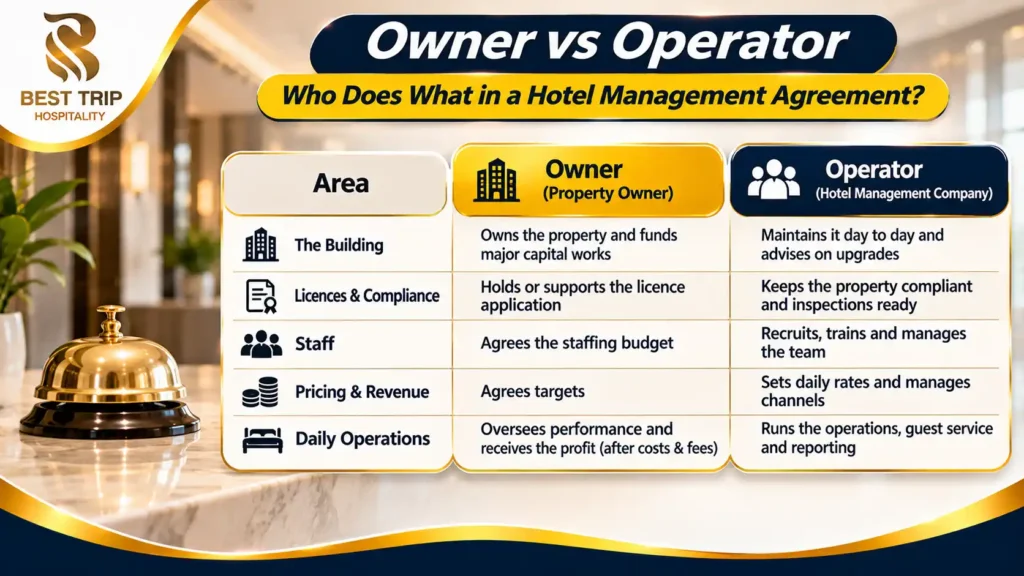
| Area | Owner usually | Operator usually |
|---|---|---|
| The building | Owns it and funds major capital works | Maintains it day to day and advises on upgrades |
| Licences | Holds or supports the licence application | Keeps the property compliant and inspections ready |
| Staff | Agrees the staffing budget | Recruits, trains and manages the team |
| Pricing | Agrees targets | Sets daily rates and manages channels |
| Sales | Approves the plan | Runs direct sales, booking sites and corporate accounts |
| Guests | Handles reception, housekeeping and service | |
| Money | Receives the profit after costs and fees | Collects revenue, pays costs and reports results |
The exact split is set in the management agreement, so read it carefully.
What a Hotel Management Company Does Day to Day

Licensing and compliance
Hotels and serviced apartments in Saudi Arabia must be licensed by the Ministry of Tourism and meet other requirements, including Civil Defense safety rules and municipal licensing. Guests must be registered through the Ministry of Interior’s Shomoos system. An operator keeps all of this running, from renewals to inspections. Owners and guests can confirm a property’s status using the steps in our guide on how to check a hotel license in Saudi Arabia.
Staffing and training
The operator recruits and manages reception, housekeeping, maintenance and sales staff, sets shift patterns for 24-hour operations, and trains the team to a consistent standard.
Pricing and revenue
Rates in Jeddah change with Ramadan, Eid, Hajj season, school holidays and major events. A good operator adjusts prices daily, decides which dates to protect for longer stays, and balances occupancy against average rate. Our Jeddah booking calendar shows how demand moves through the year.
Sales and distribution
Most properties sell through several channels at once: booking sites, the property’s own website, phone and WhatsApp, and corporate accounts. Booking sites bring reach but charge commission, while direct bookings keep more revenue with the property. Our guide to booking direct vs booking sites explains the difference from the guest’s side.
Guest service and reception
The operator runs check-in and check-out, handles requests and complaints, and manages reviews on booking sites and maps.
Housekeeping and maintenance
Units must be cleaned and checked between guests, linen managed, and faults fixed quickly. In serviced apartments, housekeeping often runs on request rather than daily. Our guide to serviced apartment housekeeping explains how that works for guests.
Safety and security
Fire equipment, CCTV, key systems and emergency procedures need regular checks and trained staff. Our hotel safety checklist shows what guests look for when they arrive.
Finance, tax and reporting
The operator collects payments, issues invoices, charges VAT and the municipality fee correctly, and reports results to the owner. Our guide to hotel taxes in Saudi Arabia explains both charges.
Why Owners Hire a Management Company
- Time. A 24-hour business needs constant attention.
- Experience. Pricing, channel management and compliance take specialist knowledge.
- Staff. An operator already has trained people and systems.
- Scale. An operator running several properties can share marketing, sales and purchasing costs.
- Consistency. Standard procedures keep service steady even when staff change.
The Market Owners Are Operating In
Saudi Arabia’s hospitality supply is growing fast. According to GASTAT data reported by Arab News in July 2026, licensed tourism hospitality facilities rose 22.7% year on year to 6,122 in the first quarter of 2026. Serviced apartments and other non-hotel facilities made up 3,159 of them, slightly more than half.
In the same quarter, occupancy in serviced apartments and other facilities was 51.6%, compared with 60.8% for hotels. More supply means more competition, which makes pricing, distribution and service quality more important for every owner.
How Management Fees Are Usually Structured
Fees differ a lot between international brands and local independent operators, and between hotels and serviced apartments. Common elements include:
- A base fee, usually a percentage of total revenue.
- An incentive fee, linked to profit, often gross operating profit.
- Other charges, such as sales and marketing contributions, booking system costs or reservation fees.
What the market shows
HVS, a hospitality consultancy, published a survey of hotel management agreements in the Middle East and Africa in September 2026. Respondents commonly reported base fees of around 1.5% to 2.0% of revenue. HVS also found that many agreements use performance tests, often combining a revenue index with a profit hurdle, and that exit rights for owners remain limited. These figures mainly reflect branded hotels and are indicative only.
What to watch for as an owner
- How “revenue” and “profit” are defined.
- Which costs the operator can charge to the property.
- Whether there is a performance test, and what happens if it is failed.
- How and when you can end the agreement.
At Best Trip Hotels, terms are agreed property by property, based on the building, its location and the services required.
Management Agreement, Lease or Franchise?
Owners usually choose between three models.
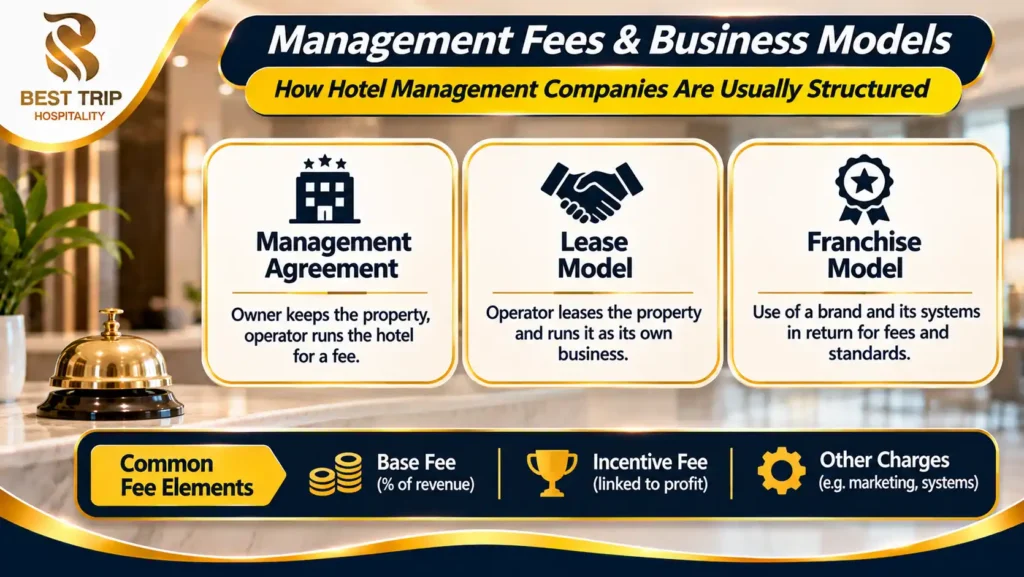
| Model | Who runs the business | Who takes the operating risk | Owner’s income |
|---|---|---|---|
| Management agreement | Operator, on the owner’s behalf | Mainly the owner | Profit after costs and fees |
| Lease | Operator, as tenant | Mainly the operator | Fixed or partly fixed rent |
| Franchise | Owner or a third-party manager, under a brand | The owner | Profit after costs, franchise fees and brand standards |
Each model trades control against risk. A management agreement keeps the upside with the owner, while a lease gives more predictable income.
Managing a Hotel vs Managing Serviced Apartments
The core work is the same, but the daily rhythm differs. A hotel sells shorter stays, so turnover, front desk workload and cleaning frequency are higher. Serviced apartments attract families, business travellers and longer stays, so the focus shifts to kitchens, laundry, weekly and monthly pricing, and fewer but longer bookings.
| Area | Hotel | Serviced apartments |
|---|---|---|
| Typical stay | One to a few nights | Several nights to several months |
| Housekeeping | More frequent | Often on request or scheduled |
| Unit fit-out | Bedroom and bathroom | Living area, kitchenette or kitchen, appliances |
| Pricing focus | Nightly rates and events | Nightly, weekly and monthly rates |
| Main guests | Short visitors, transit, events | Families, business stays, relocations |
| Maintenance load | Linen and room wear | Appliances, kitchens and furniture |
An operator that runs both can advise which model suits your building, or whether a mix of daily and monthly units makes more sense.
The First 90 Days With a New Operator
Handing over a building is a project, not a single day. A typical transition looks like this:
- Weeks 1 to 2: review. The operator inspects every unit, checks licences, safety equipment and contracts, and reviews past performance if the property was already trading.
- Weeks 3 to 6: setup. Staff are hired or retrained, booking channels and the reservation system are set up, photos and descriptions are refreshed, and prices are loaded.
- Weeks 7 to 12: trading and tuning. The property sells under the new team. Prices, channel mix and housekeeping routines are adjusted based on early results, and the first owner reports are issued.
Owners should treat the first full quarter as a learning period, and judge results over a full year of seasons rather than a single month.
Common Mistakes Owners Make
- Choosing on fee alone. A lower fee means little if the operator fills fewer units or sells at lower rates.
- Skipping the definitions. Unclear terms for revenue, costs or profit cause most later disputes.
- Underfunding the fit-out. Worn furniture and weak Wi-Fi show up quickly in guest reviews.
- Relying on one booking channel. Heavy dependence on a single booking site raises commission costs and risk.
- No exit plan. Every agreement should say clearly how it ends.
Questions to Ask Before Signing
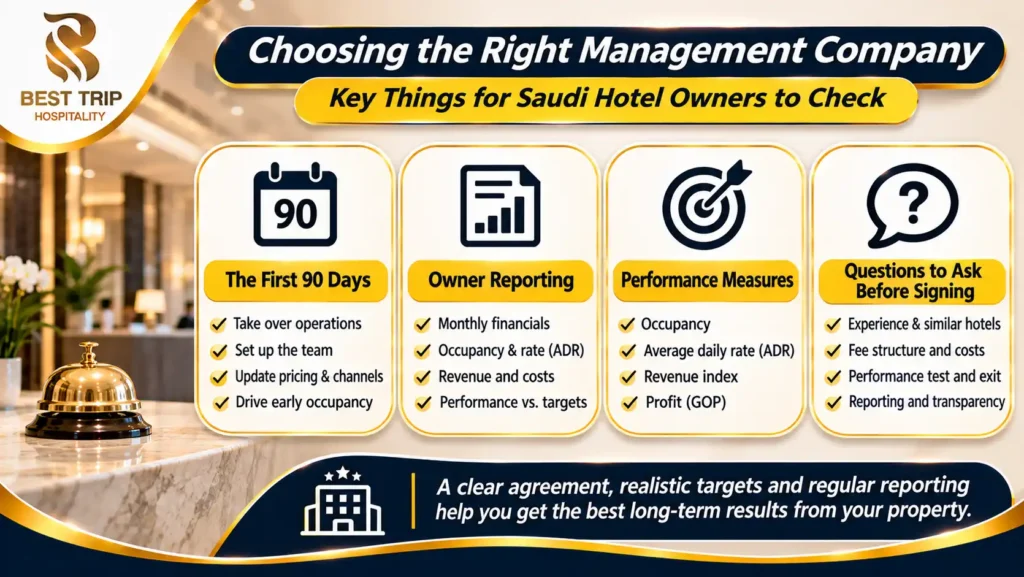
- Which properties do you already run, and can I visit them?
- Who will run my building day to day?
- How do you set prices and choose booking channels?
- What reports will I receive, and how often?
- How are fees calculated, and what else will be charged?
- Who approves budgets and major spending?
- How do you handle licensing, inspections and guest registration?
- What happens if results fall below target?
- How long is the agreement, and how can it end?
What Good Owner Reporting Looks Like
Owners should receive clear, regular information, not just a bank transfer. A monthly owner report usually covers:
- Occupancy, the share of available units sold.
- Average daily rate (ADR), the average price per occupied unit.
- RevPAR, revenue per available unit, which combines the two.
- Revenue by channel, such as direct, booking sites and corporate.
- Costs against budget.
- Guest reviews and complaint trends.
- Maintenance completed and planned.
How Best Trip Hotels Works With Owners
Best Trip Hotels is a Saudi hospitality company based in Jeddah, focused on hotel management, hotel operations and serviced accommodation. According to our About Best Trip Hotels page, the company’s roots go back to around 2010, when founder Ayad Alabbasi worked in hotel marketing and short-term operations, and it now manages hotel buildings for owners under contractual agreements.
| Year | Milestone |
|---|---|
| 2021 | Took on Best Trip Paris in Jeddah, with more than 36 rooms |
| 2022 | Added Al Andalus Tolen, Best Trip City Zone and Best Trip Valencia in Jazan |
| 2023 | Added Best Trip Marsilia in Jeddah, with more than 54 rooms |
| April 2025 | Added Best Trip Milano in Al Ajaweed, with more than 38 apartments |
| June 2025 | Launched the official website |
| August 2025 | Added Best Trip Istanbul, with more than 44 furnished apartments |
The company’s internal functions include general management, operations, marketing, digital marketing, corporate sales, finance, accounting, human resources, planning and development, and purchasing.
Our properties range from a hotel with sea-view rooms to family apartment buildings and dedicated monthly properties. You can see examples on the Best Trip Paris, Best Trip Milano and Best Trip Istanbul branch pages.
Is Your Building a Good Fit?
A management arrangement usually works best when:
- The building has enough units to support 24-hour reception and housekeeping.
- It is in a location with steady demand, such as near the airport, business districts, hospitals or main roads.
- It holds, or can obtain, the required licences.
- The owner is willing to invest in furniture, maintenance and upgrades when needed.
Smaller buildings can still work well, especially as serviced apartments or monthly stay properties.
Frequently Asked Questions
What does a hotel management company do?
It runs a hotel or serviced apartment building for its owner, covering licensing, staff, pricing, sales, guest service, housekeeping, maintenance and financial reporting.
What is the difference between a hotel owner and a hotel operator?
The owner owns the building. The operator runs the business inside it, usually under a management agreement.
How are hotel management companies paid?
Usually through a base fee linked to revenue, sometimes with an incentive fee linked to profit. HVS reported typical base fees of around 1.5% to 2.0% of revenue in its 2026 Middle East and Africa survey, mainly for branded hotels.
Can a management company run serviced apartments?
Yes. Many operators in Saudi Arabia, including Best Trip Hotels, run serviced apartment buildings as well as hotels.
Who holds the licence in a management arrangement?
It depends on the agreement and the property. The operator is usually responsible for keeping the property compliant day to day.
How many properties does Best Trip Hotels manage?
Seven properties in Jeddah and Jazan, including one hotel, four daily serviced apartment buildings and two monthly properties.
How can I talk to Best Trip Hotels about my building?
Contact our team with your building’s location, number of units and current status, and we will arrange a conversation.
Talk to Best Trip Hotels About Your Property
If you own a hotel or apartment building in Jeddah or Jazan and want it run professionally, we would like to hear from you. Our team brings experience in operations, pricing, sales and guest service across seven properties, from sea-view hotel rooms to monthly family apartments.
Tell us about your building: its location, number of units, licence status and what you want to achieve. We will explain how we would run it and what the arrangement could look like.
Contact our head office on +966 547010115 by phone or WhatsApp, 24 hours a day, or contact Best Trip Hotels through our website.
Sources
- Best Trip Hotels, About Us (history, services, functions): https://besttripbt.com/about-us/
- Arab News, Saudi tourism hospitality facilities grow 23% in Q1: GASTAT (5 July 2026): https://www.arabnews.com/node/2649721/business-economy
- HVS, The Evolution of Hotel Management Agreements: Adapting to a Value-Focused Market in the Middle East and Africa (21 September 2026): https://www.hvs.com/article/10564-The-Evolution-of-Hotel-Management-Agreements-Adapting-to-a-Value-Focused-Market-in-the-Middle-East-and-Africa
- Best Trip Hotels, Services: https://besttripbt.com/services/
Leave a Reply