
 العربية


South Jeddah is the mostly residential, family-focused side of the city. Its best-known districts for visitors are Al Ajaweed (with the Al Hada area beside it) and Prince Fawwaz, which is split into North and South. These areas sit closer to the Makkah-bound roads than the northern suburbs, have lower everyday prices and larger homes, and are a drive from Al Balad. The trade-offs are a longer trip to the airport and fewer tourist sights within walking distance.
Most English travel content about Jeddah stops at the Corniche, Al Balad and the northern malls. South Jeddah rarely gets a mention, even though thousands of families, workers and pilgrims base themselves there every year.
This guide explains what “south Jeddah” actually covers, how Al Ajaweed and Prince Fawwaz differ, how the area connects to Makkah and the rest of the city, and who it suits. Best Trip Hotels runs two properties here, Best Trip Milano in the Al Ajaweed and Al Hada area, and Best Trip Marsilia in Prince Fawwaz South, so the practical notes reflect what our guests in the south ask us most.
What Counts as South Jeddah
There is no single official boundary, but property portals and residents use “south Jeddah” for the districts below the historic centre and the central business areas.
Aqar, one of Saudi Arabia’s largest property portals, files these districts under its “South of Jeddah” listings:
- Al Ajaweed (also spelled Al Ajawid)
- Al Amir Fawwaz North and Al Amir Fawwaz South
- Al Rawabi
- Al Jamiah
- As Sabeel
- Al Hindawiyah
- Al Mahjar
- Al Waziriyah
- Ash Shifa
- Al Sorouriyah
Some of these, such as Al Hindawiyah, sit close to the old city, while others, such as Al Ajaweed and Prince Fawwaz, are newer residential areas further out.
South Jeddah Districts at a Glance
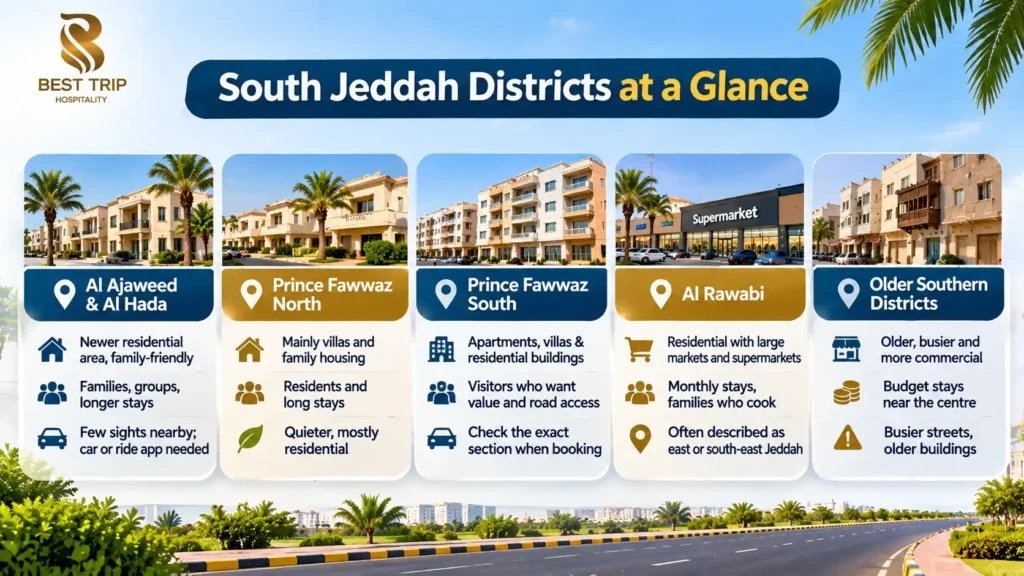
| District | Character | Best for | Things to know |
|---|---|---|---|
| Al Ajaweed and the Al Hada area | Newer residential streets, family homes, local parks | Families, groups, longer stays | Few sights nearby; a car or ride app is needed |
| Prince Fawwaz North | Mainly villas and family housing | Residents and long stays | Quieter, mostly residential |
| Prince Fawwaz South | Apartments, villas, residential buildings, local shops | Visitors who want value and road access | Check the exact section when booking |
| Al Rawabi | Residential with large markets and supermarkets | Monthly stays, families who cook | Often described as east or south-east Jeddah |
| Older southern districts (Al Hindawiyah, Al Mahjar, Al Waziriyah) | Older, busier, more commercial | Budget stays near the centre | Busier streets, older buildings |
Al Ajaweed and the Al Hada Area
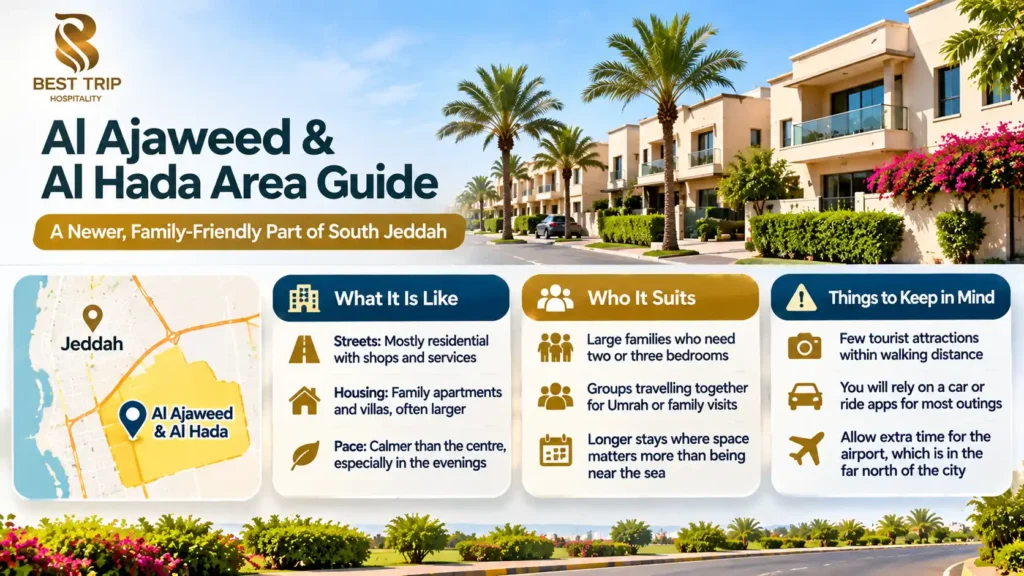
Al Ajaweed is one of the newer residential districts in south Jeddah. Local property listings describe it as a family area with schools, mosques, markets and services close by, and some homes look out over Al Ajaweed Park.
Best Trip Milano describes its location as “the Al Ajaweed/Al Hada area”, and many locals use both names together for this part of the south.
What it is like
- Streets: Mostly residential, with shops and services on the main roads.
- Housing: Family apartments and villas, often larger than in central districts.
- Pace: Calmer than the centre, especially in the evenings.
Who it suits
- Large families who need two or three bedrooms.
- Groups travelling together for Umrah or family visits.
- Longer stays where space matters more than being near the sea.
Things to keep in mind
- There are few tourist attractions within walking distance.
- You will rely on a car or ride apps for most outings.
- Allow extra time for the airport, which is in the far north of the city.
Prince Fawwaz: North and South
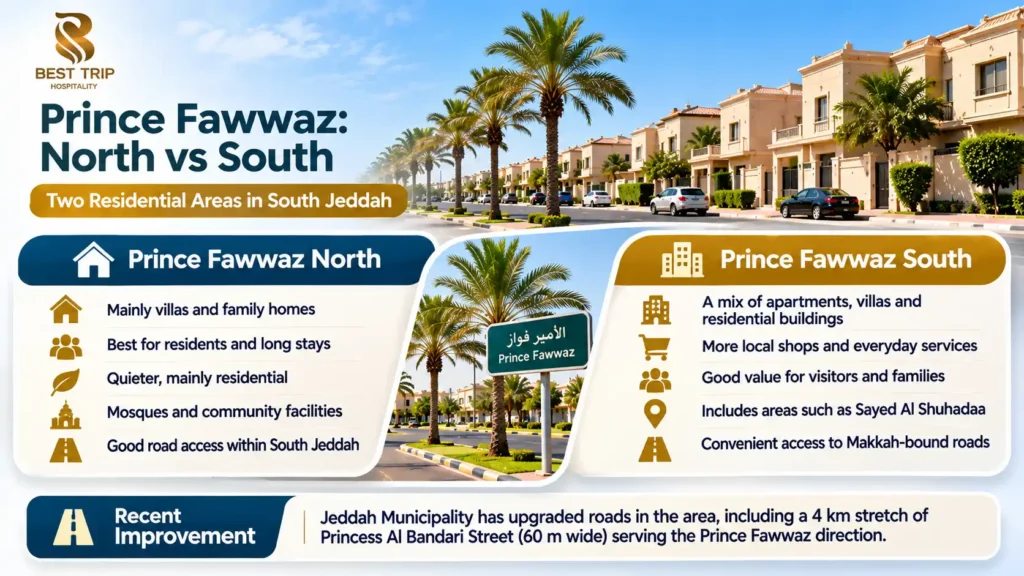
Prince Fawwaz (Al Amir Fawwaz) is one of south Jeddah’s best-known districts. It began as a large planned housing development. Archnet, drawing on the Aga Khan Trust for Culture, records the Prince Fawwaz Co-operative Housing scheme in 1985 as a development of about 1,200 housing units grouped into distinct clusters, each served by feeder roads with shared facilities between them.
Today the district is split into two parts that municipal records and property portals list separately:
- Al Amir Fawwaz Al Shamali (North): Mainly villas and family homes.
- Al Amir Fawwaz Al Janoubi (South): A wider mix of apartments, villas, residential buildings and small commercial services.
What it is like
Rakez describes Prince Fawwaz as a practical, family-focused district whose appeal “does not come from waterfront views, luxury towers, or proximity to the premium northern districts”. Mosques and community facilities are spread across both sections, with shops, pharmacies and food outlets around the residential blocks.
Recent improvements
Jeddah Municipality has upgraded roads serving the southern neighbourhoods. Rakez notes a 4 km stretch of Princess Al Bandari Street, 60 m wide, developed to serve the Prince Fawwaz direction.
Who it suits
- Visitors who want a residential base with good road links.
- Families on a budget.
- Guests with work, study or appointments in southern or south-eastern Jeddah.
Best Trip Marsilia serviced apartments sit on Sayed Al Shuhada Street in the Al Amir Fawwaz Al Junoobi district.
Getting to Makkah From South Jeddah
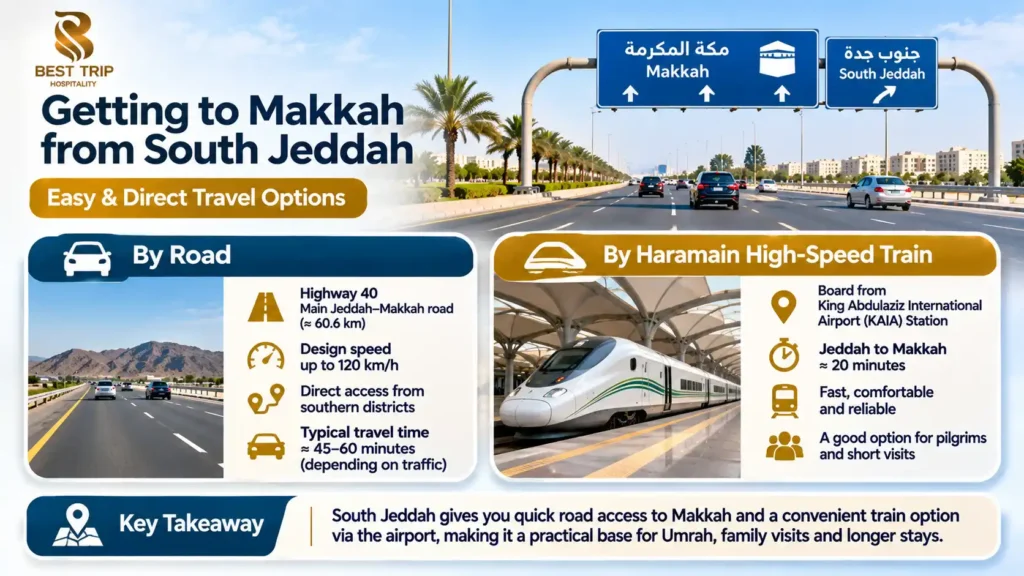
Road access to Makkah is the main reason many visitors look at the south of the city.
By road
- Highway 40: Saudipedia describes the Jeddah to Makkah road as a five-lane highway of about 60.6 km, with a design speed of 120 km/h. It starts at its junction with Highway 5 in Jeddah.
- From the south: Southern and south-eastern districts can usually reach the Makkah-bound roads without crossing the busy central and northern parts of the city.
- The new Jeddah Makkah Direct Road: This 62 km route starts in An Nuzhah in north Jeddah, near the airport, and ends at Makkah’s Fourth Ring Road. Three phases are open, and the Ministry of Transport and Logistics reported the final phase at 49% complete. It mainly helps travellers in the north.
Drive times to the Haram vary a lot with traffic, prayer times and the season. Plan for around an hour or more, and leave extra time in Ramadan.
By train
The Haramain High Speed Railway leaves from two Jeddah stations: Al Sulaymaniyah in the central-east of the city and the airport station in the north. From south Jeddah, Al Sulaymaniyah is usually the closer of the two. Our guide to staying in Jeddah for Umrah compares the full cost and time of basing yourself in Jeddah rather than Makkah.
Getting Around From South Jeddah
Travel times below are estimates for normal traffic by car. Evening rush hours and Thursday nights can add 15 to 30 minutes.
| Destination | Approx. drive time | Notes |
|---|---|---|
| Al Balad (historic Jeddah) | 20 to 30 minutes | Park outside the old lanes |
| Central Corniche | 25 to 35 minutes | Best after sunset |
| Jeddah Al Sulaymaniyah Haramain station | 20 to 30 minutes | Trains to Makkah and Madinah |
| King Abdulaziz International Airport | 35 to 50 minutes | Longer at peak times |
| Makkah (Haram area) | Around 1 hour or more | Depends on route and traffic |
- Ride apps: Uber and Careem cover the south, though waiting times can be longer than in the centre late at night.
- Car: The most flexible option, especially for families and trips to Makkah.
- Walking: Fine inside residential blocks and to local shops, but not for sightseeing.
Daily Life in South Jeddah
Shopping and groceries
Supermarkets, bakeries, pharmacies and local markets are spread across the residential districts. Al Rawabi, in the south-east, has some of the largest markets in the area, including the Jeddah Dates Market and Lulu Hypermarket listed on our Istanbul property page.
Food
Expect everyday Arabic restaurants, grills, bakeries and family takeaways rather than fine dining. Many visitors cook at home and head to Al Balad or the Corniche for a special dinner.
Healthcare and study
Clinics and pharmacies sit along the main roads. Rakez notes that the area can suit households with commitments in southern or south-eastern Jeddah, including King Abdulaziz University.
Pace of life
South Jeddah is quieter in the evenings than the northern districts and the Corniche. Weekends bring families out to parks and local shopping streets rather than large malls.
Pros and Cons of Staying in South Jeddah
Pros
- Road access towards Makkah without crossing the city.
- Larger apartments and family homes.
- Lower everyday prices than many northern districts.
- Quieter residential streets.
Cons
- Long drive to the airport.
- Few tourist sights within walking distance.
- Most outings need a car or ride app.
- Less nightlife and fewer large malls nearby.
South Jeddah vs Other Parts of the City
Jeddah is long and spread out, so each part of the city suits a different trip.
- Choose south Jeddah for family space, value and road access towards Makkah.
- Choose the centre if Al Balad and the old city are your priority. Our guide to Al Baghdadiyah, Jeddah covers the district between the old town and the sea.
- Choose the north for the airport, big malls and the airport Haramain station. See our An Nuzhah, Jeddah guide for the district closest to KAIA.
For a full comparison of every major area by trip type, read our guide on where to stay in Jeddah.
Tips for Visitors Staying in South Jeddah
- Confirm North or South Prince Fawwaz before booking, as the two sections are listed separately.
- Test drive times at peak hours if you have fixed appointments.
- Download offline maps. Some newer streets may not show clearly on every app.
- Keep the airport in mind. Leave early for flights, especially in the evening.
- Plan Makkah trips around prayer times and traffic near the Haram.
Staying in South Jeddah With Best Trip Hotels
Best Trip Hotels has two daily-stay properties in south Jeddah and a monthly property in the south-east.
Best Trip Milano
- Location: The Al Ajaweed and Al Hada area.
- Units: Standard studios, one-bedroom, two-bedroom and three-bedroom apartments.
- Good for: Large families and groups who need extra bedrooms.
- Facilities: Air conditioning, Wi-Fi, Smart TVs, kitchen facilities in selected units, housekeeping, parking and reception support.
Best Trip Marsilia
- Location: On Sayed Al Shuhada Street in the Al Amir Fawwaz Al Junoobi district.
- Units: Standard studios, deluxe studios and two-bedroom deluxe apartments.
- Facilities: Kitchenettes, daily housekeeping, a 24-hour front desk, room service, free private parking, elevator access and accessible facilities.
- Good for: Couples, families and Umrah visitors who drive.
Best Trip Istanbul (monthly)
Best Trip Istanbul in Al Rawabi is our monthly property on the south-east side of the city. It offers studios, one-bedroom and two-bedroom apartments with separate living rooms and equipped kitchenettes, close to large supermarkets and markets. It suits extended visits, work assignments and families staying for weeks rather than days. Monthly terms are arranged directly with the property.
Rates
Our room rates change with the season, demand and length of stay, and they can go up or down during Ramadan, school holidays and the Umrah peak. For current prices, check the property page or the booking engine on our website for your dates. Rates on the website are shown before 15% VAT and the city tax.
If you are deciding between room types, our comparison of serviced apartment vs hotel explains the space and cost trade-offs. You can also browse all our serviced apartments in Jeddah or see every location under Best Trip Hotels.
Frequently Asked Questions
Which areas are in south Jeddah?
Commonly listed south Jeddah districts include Al Ajaweed, Prince Fawaz North and South, Al Rawabi, Al Jamiah, As Sabeel, Al Hindawiyah, Al Mahjar, Al Waziriyah, Ash Shifa and Al Sorouriyah.
Is south Jeddah good for Umrah visitors?
Yes, especially for families who drive. Southern and south-eastern districts can reach the Makkah-bound roads without crossing the centre. For the train, Al Sulaymaniyah station is usually the closest.
What is the difference between Prince Fawwaz North and South?
They are two separately listed sections of the same district. The North is mainly villas and family homes, while the South has a wider mix of apartments, villas, residential buildings and local shops.
How far is south Jeddah from the airport?
Expect around 35 to 50 minutes by car in normal traffic, and longer at peak times, since the airport is in the far north of the city.
Is south Jeddah cheaper than north Jeddah?
Everyday costs and housing are generally lower in the south than in the premium northern districts.
Where is Al Hada in Jeddah?
Locals and Best Trip Milano use “Al Ajaweed/Al Hada area” for the same part of south Jeddah. Check the exact pin on a map when booking or arranging a pick-up.
Leave a Reply